Travel Planning Hub
Start here to plan your trip, compare options, and explore every TLGA planning guide.
Packing & Gear Guide
What to pack, what to skip, and how to build a lighter travel setup that works.
Last updated: March 2026 by Corey Gasman
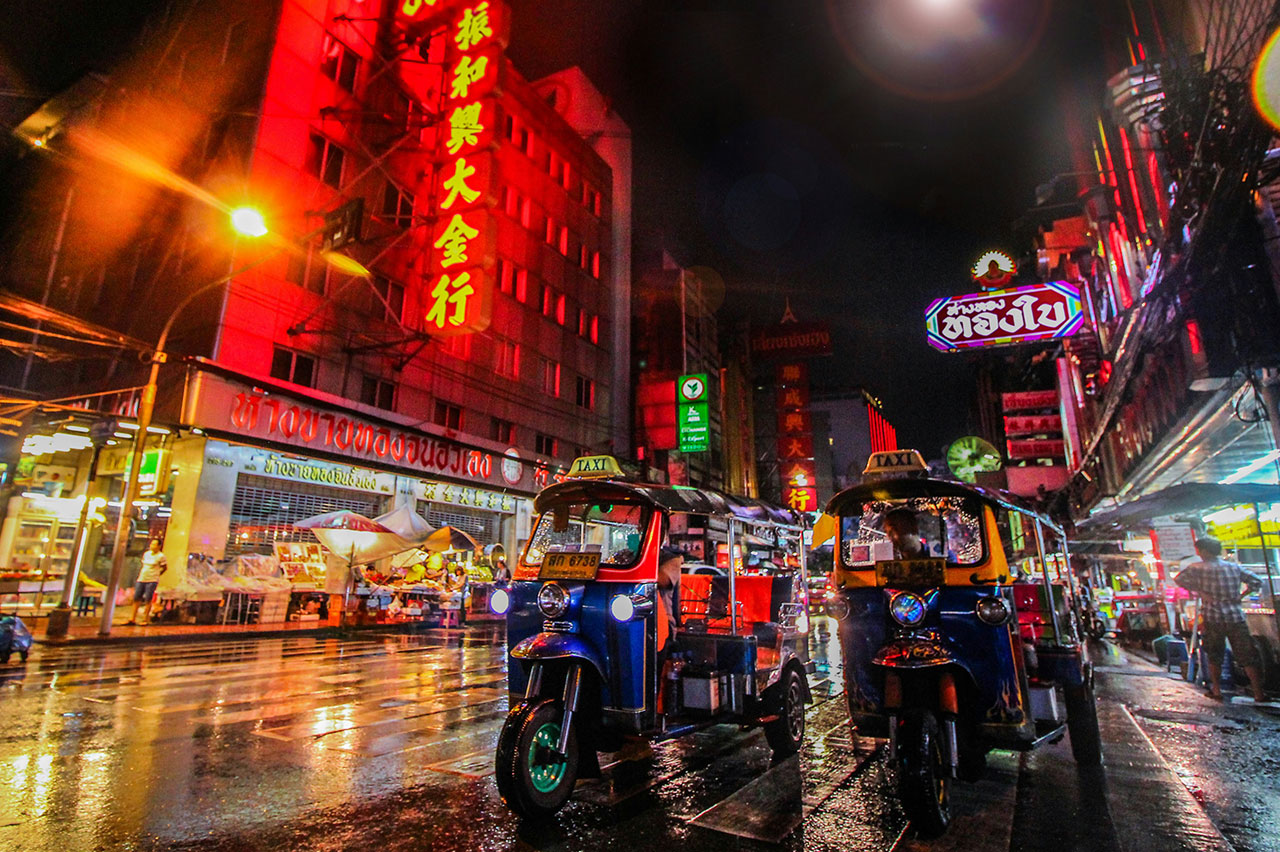
No trip to Bangkok is complete without a neon-lit tuk-tuk ride through the city’s buzzing streets.
From the Editor:
Bangkok is a full-volume city. It is intense in the best way, and it can also wear you out fast if you plan it like a checklist. The fix is simple: pick the right base, learn two transit tricks, and build your days around one morning mission and one night mission.
Do that and Bangkok becomes the best kind of chaos: temples, Chinatown backstreets, rooftop views, and $2 meals that somehow taste like a life upgrade.
Having explored Thailand four different times, I have almost always used Bangkok as my base. Between those trips, I have been in and out of the city close to a dozen times. Every visit feels different. The Big Mango always has something new to offer. Over the years, I have moved from extreme budget travel to mid-range comfort to full-on luxury, and Bangkok has met me at every level.
If you are coming from somewhere like Minneapolis, stepping into a Southeast Asian megacity feels like someone turned your senses up to maximum. Street vendors everywhere. Smoke from grills. The smell of wok-fried noodles and sweet fruit. Friendly chaos. And then the punchline: how affordable it all is.
Over the last 20 years, I have seen Bangkok from almost every angle. On more recent trips, that has meant trading plywood walls for a luxury high-rise hotel on the 53rd floor, skyline views, and cocktails at the sky bar on top, while still doing the temples, Chinatown, late nights, and early mornings that define the city.
My first trip to Bangkok was back in 2004. I stayed in what you might generously call a hostel, but it was really a tiny plywood room where the walls did not even reach the ceiling. One little fan. One bare light bulb. A long hallway with a shared squatter toilet. I swear the room cost about five dollars a night.
It was ridiculous, and it was incredible.
I would walk outside and eat the best shrimp pad Thai of my life for about a dollar fifty and feel like I had unlocked some kind of travel superpower. That trip permanently rewired how I thought about money, comfort, and what travel could be.
Six years later in 2010, Bangkok showed up for me in a very different way. In 2009, after the housing bubble burst, my wife Melissa and I found ourselves suddenly unemployed. Instead of staying home and spiraling, we packed bags. That reset turned into a stretch that included two weeks in Thailand, two weeks in Vietnam, and time in California in between.
That Bangkok trip landed differently. We stayed at the New Siam Riverside Hotel, right on the river. Affordable, comfortable, and perfectly located. Around fifty dollars a night for a river-view room with a balcony, air conditioning, a nice pool, and an English breakfast when you needed a break from spicy Thai food.
We were there in January, during New Year season, when the heat was brutal and the streets turned into nonstop water fights. Buckets. Hoses. Laughing strangers. The entire city playing along. I am not kidding when I say we had to leave the hotel wearing swimsuits.
I have gone from partying on Khao San Road with big bottles of Chang and bucket drinks to seeking out the finer side of the city. Rooftop views. Great hotels. Meals that feel intentional.
That is why Bangkok works. It has a version of itself for everybody.
If you give it 24 hours and learn the rhythm, how to hop a river boat to skip traffic, where quiet temples hide behind busy streets, and how the best meal of your trip might happen on a plastic stool, it gets under your skin.
This guide is designed to cut through the noise. Bangkok is massive, but you only need to master a few key neighborhoods to have an incredible trip. I will show you how to skip tourist traps, use the transport systems that actually work, and build a trip that balances chaos with calm.
Bangkok Golden Rule: Your trip quality is 80% base location and 20% timing. Pick a zone, start early, and let nights be the city’s main event.
Bangkok at a Glance
| Item | Cost (THB) | Cost (USD) | Notes |
|---|---|---|---|
| Street Pad Thai | 50–80 THB | $1.50 – $2.50 | Varies by toppings |
| Local Beer (Retail) | 45 THB | ~$1.30 | 7-Eleven price |
| BTS Skytrain | 17–62 THB | $0.50 – $1.80 | A/C comfort, avoids traffic |
| Taxi (20 min ride) | 80–150 THB | $2.40 – $4.50 | Ask for “meter on” |
| Tuk Tuk (10 min ride) | 100–200 THB | $3.00 – $6.00 | Agree on price first |
| Mid-Range Hotel | ~1,500 THB | ~$45.00 | Per night (A/C + WiFi) |
| Thai Massage (1 hr) | ~300 THB | ~$9.00 | Standard street price |
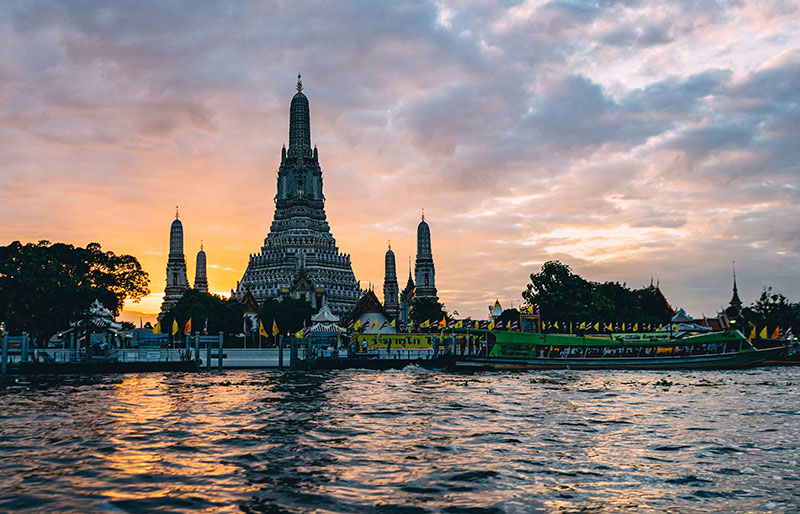
Strategy: Riverside feels like a reset. Sukhumvit is the action. Old Town is the classic chaos. Choose your base like it is the main attraction.
Bangkok is too big to “see it all.” Your experience depends entirely on where you sleep. Pick one of these three zones based on your travel style, then build simple daily loops.
| Traveler Type | Best Base | Why It Works |
|---|---|---|
| Budget and street food | Old Town (Banglamphu) | Temples, markets, iconic chaos, cheap eats |
| Mid-range comfort | Riverside | Best scenery, breezier vibe, boat access, calmer nights |
| Luxury and views | Riverside or Sukhumvit | High-rise hotels, skyline rooms, best rooftops |
| Nightlife and easy transit | Sukhumvit (near BTS) | Fast BTS access, modern convenience, late-night loop |
Rule of thumb: If you will use taxis a lot, stay near the river. If you want speed, stay near BTS/MRT.
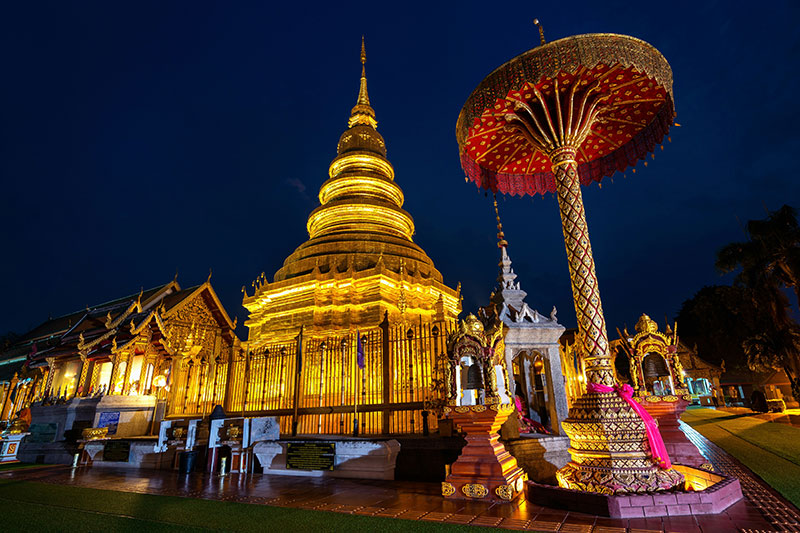
The glowing golden spires of Wat Phra Kaew (Temple of the Emerald Buddha) at night.
Bangkok works year-round, but your comfort changes a lot depending on season. The biggest factor is heat and humidity, not sightseeing.
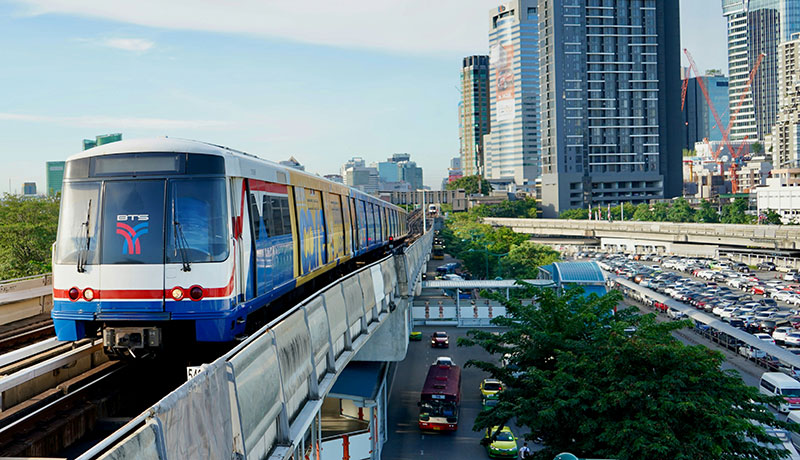
Escaping Bangkok traffic by traveling above the street on the BTS Skytrain.
This is the lifeline of modern Bangkok. The BTS is above ground, and the MRT is underground. They connect at key points like Asok and Sukhumvit.
The river is a highway. Boats are often faster than cars for Old City days.
Download Grab (Southeast Asia’s Uber). It saves you from haggling and gives you price clarity.
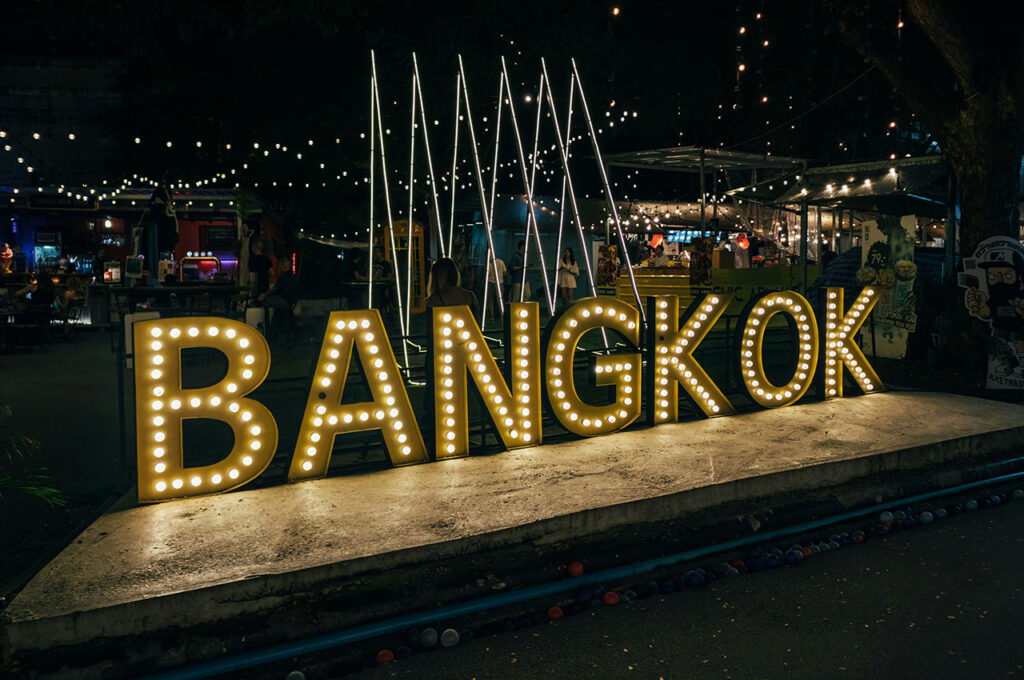
Bright lights, big city: Bangkok after dark is when the city comes alive.
Do not try to do too much. The heat will drain you. Plan one major activity for the morning and one for late afternoon or night.
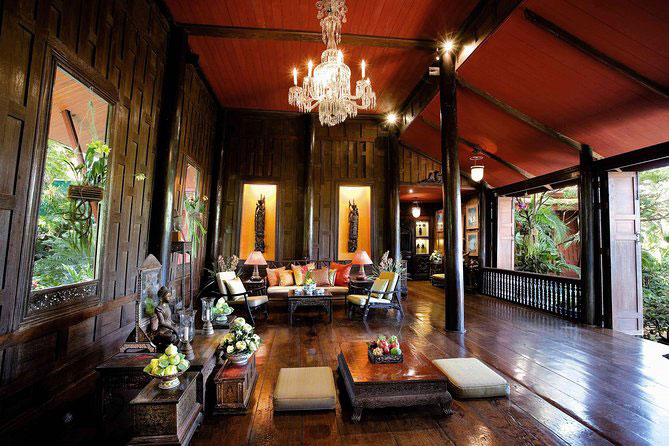
A glimpse into the Silk King’s collection: antiques and art at the Jim Thompson House.
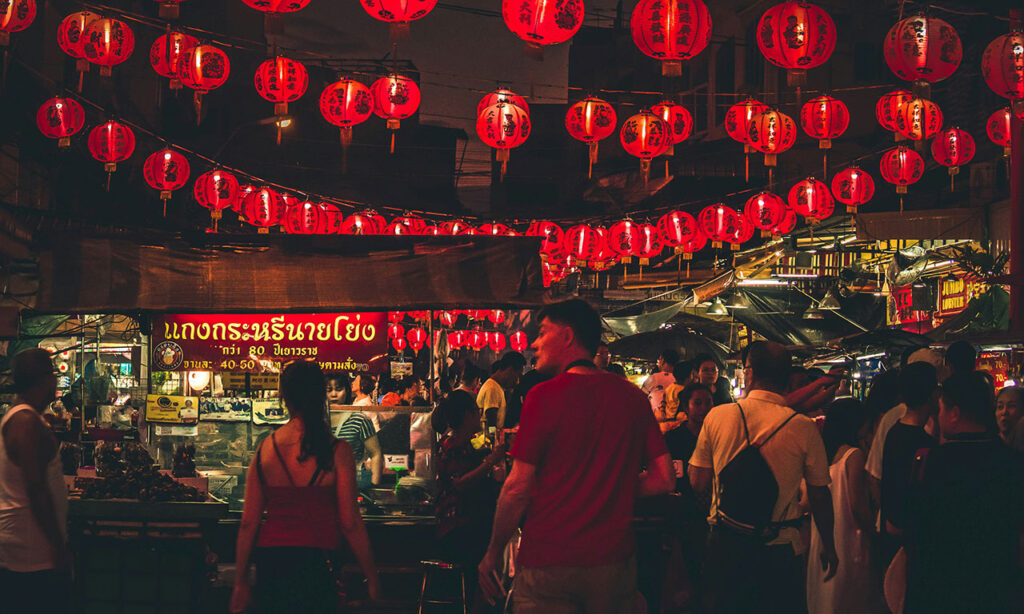
Yaowarat Road (Chinatown) under a canopy of lanterns: the ultimate street food loop.
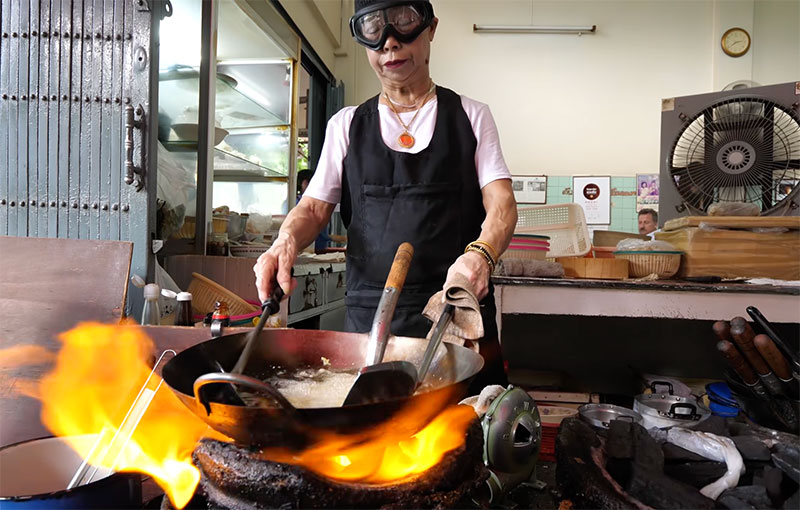
Jay Fai, the Michelin-starred “Queen of Street Food,” cooking her famous crab omelet.
Bangkok is the street food capital of the world. You do not need a reservation. You just need an appetite.
3 spots to start:
I am writing a dedicated guide on what to order, how to handle spice levels, and the stalls I return to every trip. Link coming soon.
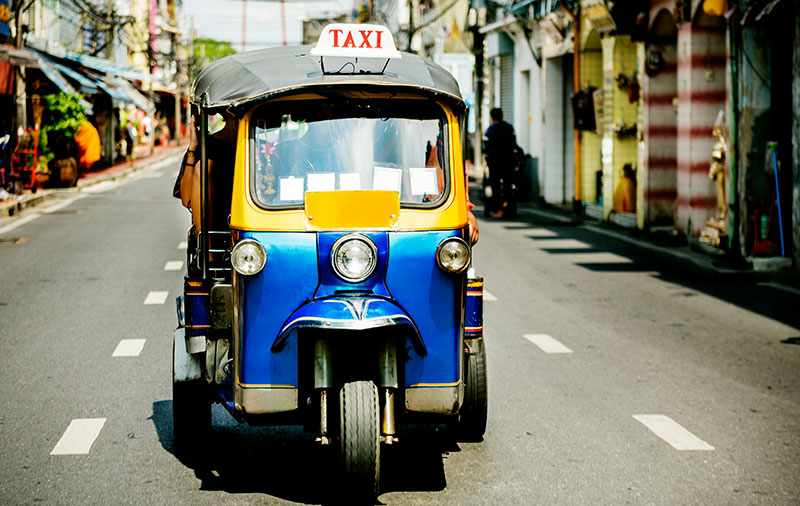
Be wary of “too cheap” rides (like 20 baht). It is often a trap that ends at a gem shop.
Bangkok is safe, but there are “soft scams” designed to separate you from your cash.
A friendly, well-dressed guy approaches you outside the temple and says the Grand Palace is closed for a holiday or cleaning. It is a lie. He wants to put you in a tuk-tuk to a gem shop. Ignore him and walk to the main gate.
If a driver offers to take you around the city for 20 baht, it is a trap. You will be driven to tailor shops and gem stores. Pay a fair price for a ride, not the scam price.
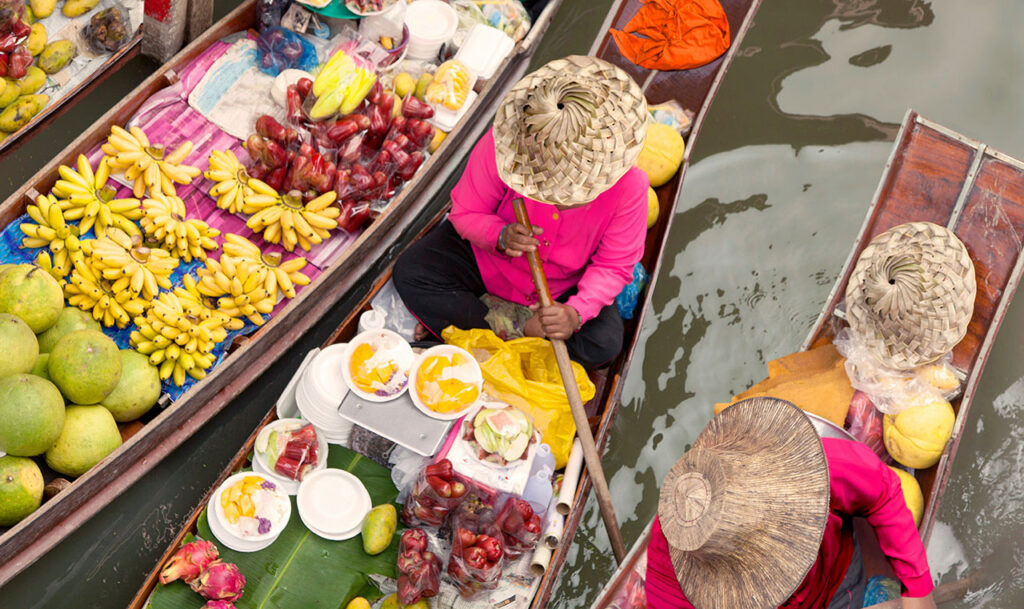
A chaotic but memorable morning on the water at Bangkok’s most famous floating market.
Some of my strongest memories from Bangkok did not come from temples or rooftop bars. They came from bad decisions, rough mornings, and showing up anyway.
One of my favorite Bangkok memories started with a terrible decision.
We had booked a floating market tour in advance, and for reasons I still cannot explain, the night before became our biggest party night of the entire trip. Khao San Road. Big Chang beers. Buckets. The works. We shut it down around 2 a.m., knowing full well our van was leaving at 7.
We never made it back to the hotel. We crashed in a McDonald’s instead, staring at the Thai version of Ronald McDonald politely bowing with his hands pressed together in a wai, which felt respectful and judgmental at the same time.
By sunrise, we were wrecked.
Picture a small van packed with equally miserable tourists, crawling out of Bangkok in heat that felt criminal. No one talking. No one smiling. Everyone silently questioning their life choices.
And then, somehow, it worked.
The floating market itself was fascinating. Boats stacked with fruit, noodles, souvenirs, and people selling their wares from the water. I am sure it was once a very real part of daily commerce, and now it is clearly more of a tourist experience, but it was still worth seeing at least once.
Rough day? Absolutely. Memorable? No question.
Here is the irony. If we had not booked that tour in advance, there is no chance we would have gone while that hungover. We would have slept it off and missed it entirely.
It perfectly captures the way Bangkok reveals itself to you. Keep your itinerary flexible, but not empty. Leave room to adapt, but do not skip the weird or inconvenient things just because they feel uncomfortable in the moment.
Bangkok often rewards you for showing up anyway.
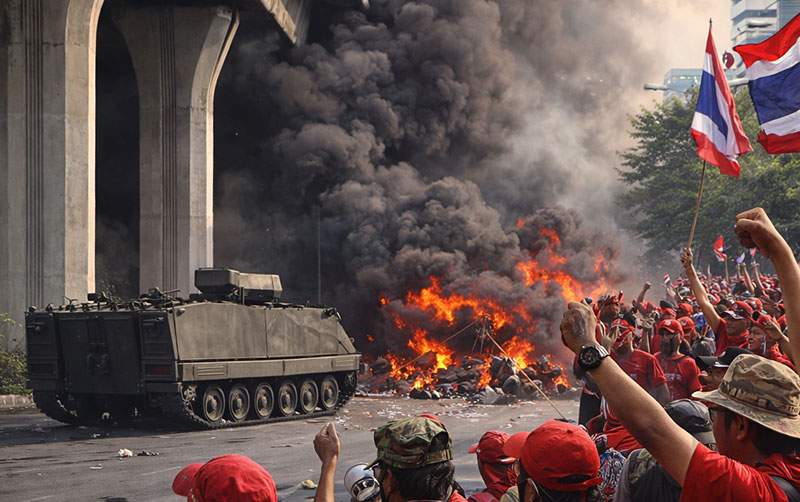
Illustrated recreation of the 2010 Red Shirt protests. This image is an artistic representation of the atmosphere we experienced.
On my second trip with my wife, Bangkok was not just chaotic; it was tense.
If you visited Bangkok in the spring of 2010, you saw a very different city. We were there during the height of the Red Shirt Protests. I vividly remember seeing armored personnel carriers (which looked like tanks to us) blocking off the major tourist districts around Ratchaprasong. At one point, we even saw the charred remains of a bus that had been burned to block the road. It was a surreal reminder that behind the street food and shopping, this is a city with a complex political history.
Months later, back in the States, we were watching Anthony Bourdain: No Reservations. It was the Thailand episode. We watched him walk through the same streets, commenting on the exact same tension we had felt. We had just come from Vietnam (where he had also been filming), unknowingly following his path through Southeast Asia right into the chaos.
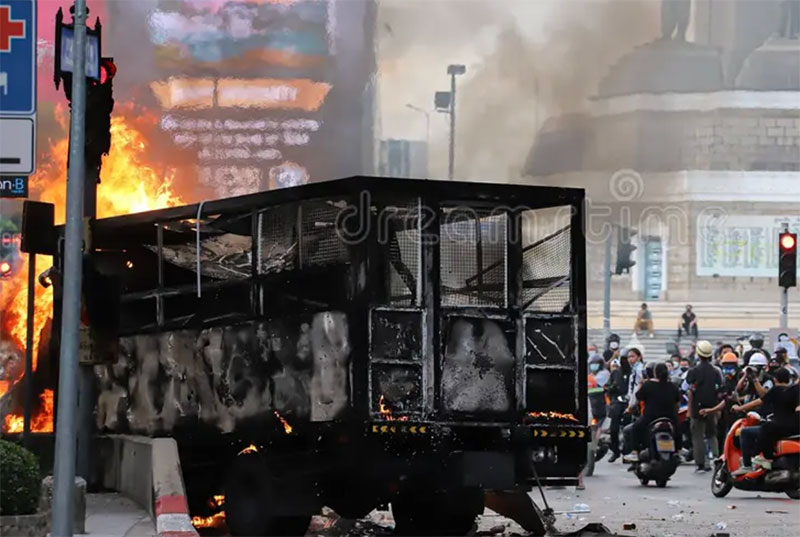
I took this photo of a burnt bus being towed away in the aftermath of the protests. It was a sobering reminder of the tension in the city that week.
Three days is the sweet spot. Two days for temples and neighborhoods, plus one day for markets, malls, or a slower reset.
Generally yes. Stick to busy stalls where food is cooked fresh and turnover is high. If it is quiet and the food looks like it has been sitting, keep walking.
Suvarnabhumi (BKK) is the main international airport and has the Airport Rail Link into the city. Don Mueang (DMK) is mostly for budget airlines and usually requires a taxi or bus connection.
BKK is usually easier for Sukhumvit and Riverside bases due to the rail link, while DMK often means a tollway taxi ride that can still get stuck in gridlock.
No. Do not drink tap water. Bottled water is cheap and everywhere. Ice in restaurants is usually safe, but when in doubt, stick to bottled drinks.