Travel Planning Hub
Start here to plan your trip, compare options, and explore every TLGA planning guide.
Packing & Gear Guide
What to pack, what to skip, and how to build a lighter travel setup that works.

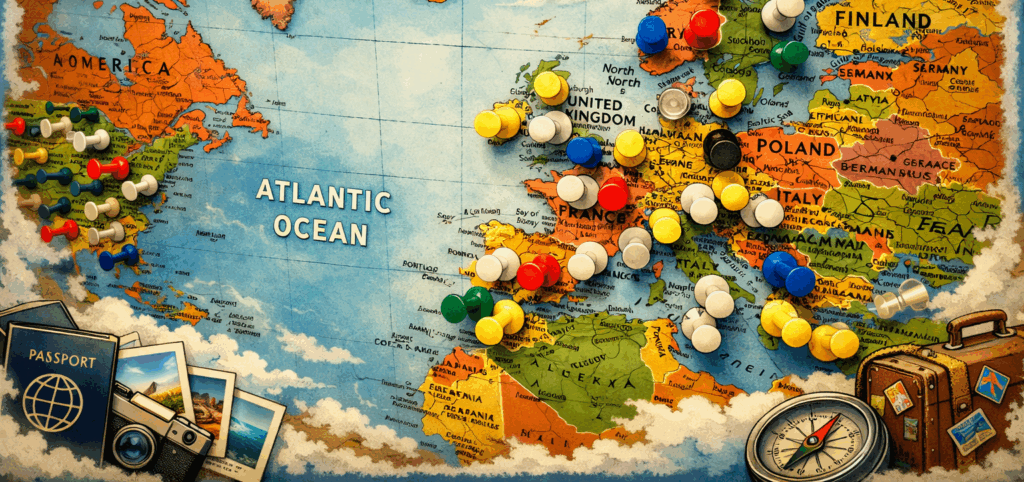
This is not a modern travel guide.
This is a time capsule.
In 2004, we walked away from our careers, packed our lives into backpacks, and traveled around the world in one long, continuous journey. These entries were written in real time, usually in internet cafes, with no smartphones, no Google Maps, and no way to fact check anything on the fly.
Travel looked completely different back then. Paper tickets. Heavy guidebooks that we would literally tear pages out of as we went. Folded maps in our pockets. Word of mouth instead of reviews.
It is wild to think about how much something like Google Maps has changed everything. Travel today is easier, faster, more efficient.
But there was something else we learned because of that.
Because we were traveling for a full year, we didn’t have everything planned. A lot of the time, we just showed up. No reservations. No backup plan. Just arriving in a new city and figuring it out.
And honestly, that shaped how I still travel today.
You don’t have to have everything booked. You don’t have to map out every stop. Yes, there are moments where planning matters, like showing up during Carnival in Brazil or peak summer in Paris or Italy. But outside of that, flexibility is one of the biggest advantages you have.
Even now, I’ll often just book a couple nights and leave the rest open.
What you’ll find here is raw travel. Unfiltered decisions, missed trains, incredible highs, and the occasional low. Each section below links out to the original entries exactly as they were written.
We didn’t leave because we were burned out or stuck. We actually liked our jobs. Rob was working at REI corporate in Seattle. I was working in Minneapolis as a creative director building magazines around sports we cared about. Life was good.
But something shifted.
It wasn’t frustration. It was curiosity. Wanderlust. The realization that we could either spread travel out across 25 years of two-week vacations, or take it all at once.
One year. No routine. Just movement.
I called Rob and told him I was thinking about quitting my job to travel around the world. He didn’t hesitate. He was in.
We bought a Round the World ticket through Delta and their partners, packed everything into backpacks, and started moving.
We built the route around one major constraint: cross the equator only once. That forced us to think strategically and shaped the entire trip.
Europe → Africa → Asia → Oceania → Home
Spain → Portugal → Morocco → France → Italy → Greece → Turkey → Germany → Austria → Czech Republic → Denmark → Sweden → Norway → Netherlands → Tanzania → Zimbabwe → Zambia → South Africa → India → Thailand → Laos → Malaysia → Australia → New Zealand → Fiji → Hawaii
Learning how to travel long-term across Europe.
Europe is where we figured it out.
Spain and Portugal eased us in with late dinners, cheap wine, and a slower rhythm. Morocco reminded us quickly that travel is not always comfortable. It can be confusing, intense, and humbling.
France and Italy slowed everything down. Long meals, alpine hikes, and wandering towns showed us that meaningful travel is not about constant movement. Greece and Turkey turned the energy back up with ferries, markets, and unfamiliar systems.
By Scandinavia, we had confidence. Long daylight, quiet villages, and fjords gave us space to breathe.
Africa changed everything.
Africa changed us.
Climbing Kilimanjaro stripped everything down to basics. Step, breathe, repeat. Safari, border crossings, and long travel days expanded everything else.
Zanzibar brought recovery. Southern Africa brought adrenaline, from Victoria Falls to South Africa, where the trip shifted into one of the most intense and memorable stretches.
Africa made the world feel bigger and, at the same time, more connected.
Sensory overload in the best way possible.
Asia was constant movement.
India was intense, layered, and unforgettable. Thailand and Laos softened the edges. Malaysia felt like a crossroads of cultures and ideas.
Somewhere along the way, we stopped feeling like tourists and started feeling like travelers.
(India and Southeast Asia entries are currently being recovered from the archives and will be added soon.)
Room to reflect after a year on the road.
Australia and New Zealand gave us space. Physically and mentally.
Fiji slowed everything down. Hawaii marked the transition home.
We were no longer chasing what was next. We were trying to understand what had just happened.
(Australia and New Zealand entries are currently being recovered from the archives and will be added soon.)
That trip changed everything.
It reshaped how I think about time, work, and what actually matters. It also laid the foundation for everything I’m building now with The Local Guide Abroad.
Back then, we were just trying to see the world.
Now, I’m trying to help people experience it better.
Start with a modern framework built from experience.