Travel Planning Hub
Start here to plan your trip, compare options, and explore every TLGA planning guide.

Packing & Gear Guide
What to pack, what to skip, and how to build a lighter travel setup that works.
A history that reshaped Ireland, scattered families across the world, and still echoes through the island today.
Last updated: February 2026 by Corey Gasman
Between 1845 and 1852, Ireland experienced one of the most devastating humanitarian disasters in modern European history. Known as the Irish Potato Famine, or An Gorta Mór (“The Great Hunger”), the crisis led to the deaths of roughly one million people and forced one to two million more to leave the country. In just seven years, Ireland lost up to a quarter of its population.
The immediate cause was a potato blight, a plant disease that arrived from North America and thrived in Ireland’s damp climate. Potatoes rotted in the ground year after year. For nearly half the population, this was catastrophic. Most rural Irish families depended almost entirely on a single variety of potato for survival, not by choice, but by necessity.
The deeper causes were political and economic. Under British rule, much of Ireland’s land was owned by Protestant landlords, many living comfortably in England. Irish Catholic tenants farmed tiny plots of poor land, just large enough to survive if the potato crop held. When it failed, there was no backup plan.
To make matters worse, Ireland continued exporting grain, cattle, and dairy to Britain throughout the famine, even as people starved. British relief efforts were limited and shaped by rigid free-market beliefs. Government aid was reduced, ports stayed open, and responsibility was shifted onto already bankrupt local communities.
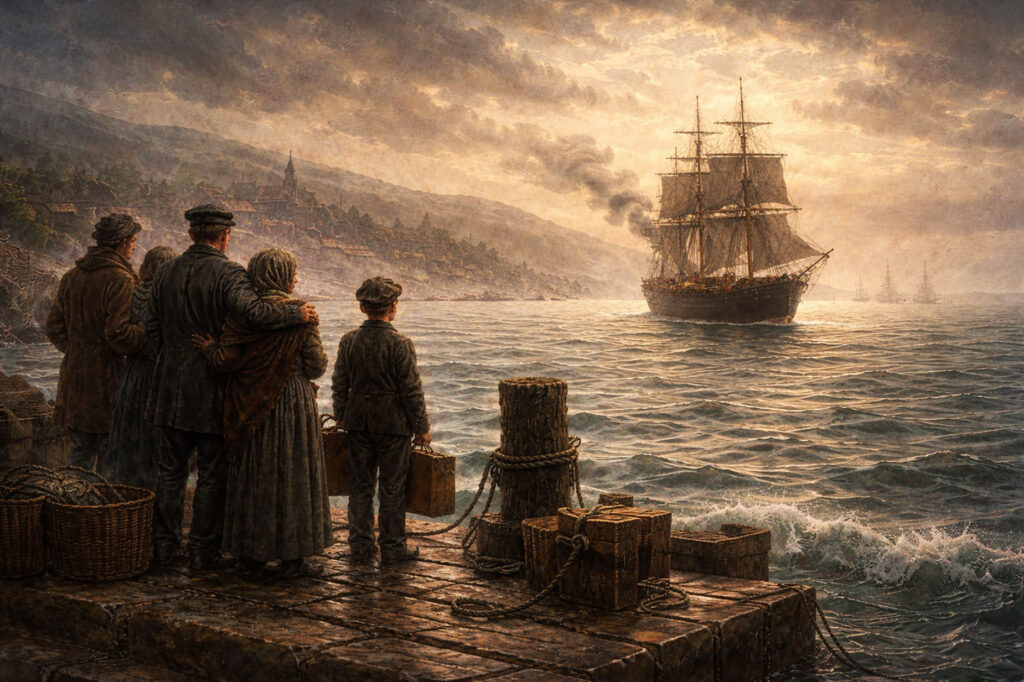
The result was not just mass starvation, but mass emigration. Entire families boarded overcrowded ships bound for America, Canada, and beyond, leaving behind a country permanently changed.
The famine did not just empty villages. It reshaped Irish identity, deepened resentment toward British rule, and helps explain why Irish heritage stretches so far beyond the island itself. For many travelers today, understanding this history adds weight to the landscapes, the stories, and the quiet pride that still defines Ireland.
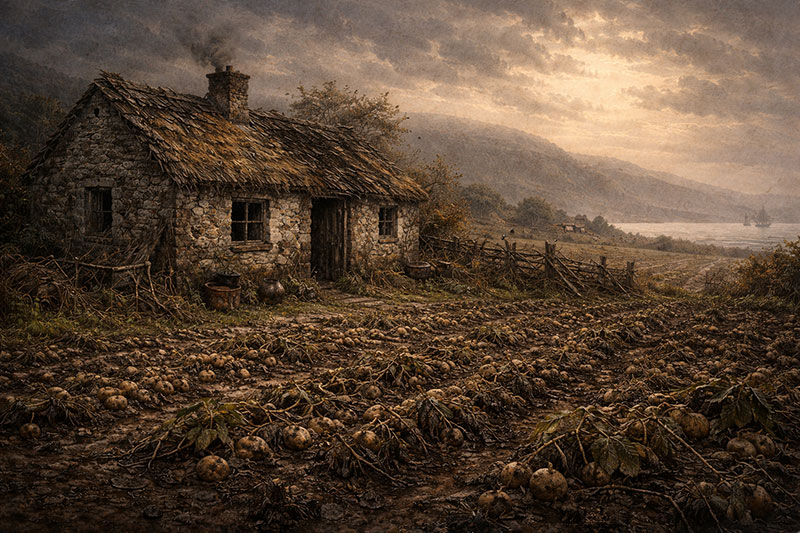
An abandoned Irish cottage near potato fields during the famine era.
When Irish families fled their homeland during the Great Famine, they did not arrive in America welcomed with open arms. They came hungry, desperate, and often uninvited. Newspapers warned they would overwhelm cities. Politicians questioned their loyalty. Signs openly declared “No Irish Need Apply.” They were portrayed as dangerous, lazy, and incompatible with American values.
Sound familiar.
The Irish left because staying meant starvation. Today’s immigrants leave for many of the same reasons. Violence, poverty, climate instability, and broken systems leave people with one choice. Go, or do not survive.
The language used to describe them has changed, but the fear behind it has not. Entire groups are reduced to labels. Threats instead of neighbors. Numbers instead of people.
History has a way of softening memories. We now celebrate Irish immigration as a success story. Parades, neighborhoods, presidents. What we forget is that acceptance came slowly, and only after generations of struggle.
The same country that now proudly claims Irish heritage once saw those immigrants as a problem to be managed, not people to be helped.
What changes societies is not walls or slogans. It is proximity. It is time. It is the simple act of recognizing humanity where fear once lived.
The Irish story reminds us that today’s outsiders are often tomorrow’s foundation. That suffering does not ask for permission before crossing borders. And that compassion, when chosen early, saves more than history books ever record.
It is worth remembering how rare it is to travel by choice, when so many in the world travel because staying is no longer possible.