Travel Planning Hub
Start here to plan your trip, compare options, and explore every TLGA planning guide.

Packing & Gear Guide
What to pack, what to skip, and how to build a lighter travel setup that works.

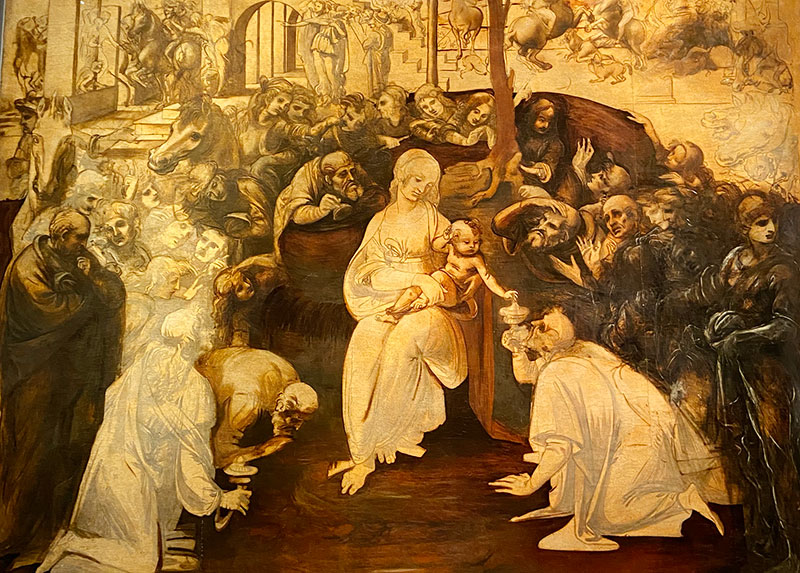
A look inside the mind of a genius: Leonardo’s unfinished Adoration of the Magi reveals his raw sketches and restless thought process. Because he never applied the final layer of paint, you can see the ghostly outlines and geometry that usually get hidden forever (Photo by Corey Gasman).
By Corey Gasman
Back in Minnesota, when I was in the 6th grade, my very first research report was on Leonardo da Vinci. I was a kid who loved to draw, and I was absolutely fascinated that a single person in the 1400s could paint with unreal precision while also filling notebooks with sketches of parachutes, helicopters, and complex scientific anatomy. He didn’t see a boundary between art and science. To him, it was all just observing the world deeply.
That report inspired me for years. So, you can imagine the impact of finally standing in Italy decades later, walking into a museum, and seeing those actual sketches with my own eyes. It is a profound experience that bridges the gap between a childhood hero and the reality of history.
If you are the type of traveler who wants to slow down and understand the soul of Italy, you have to spend time with its art. It is not about checking famous paintings off a list. It is about witnessing the moment humanity decided to look at itself differently.
Here is my personal guide to understanding the Italian Renaissance and the museums where you can feel that shift for yourself.
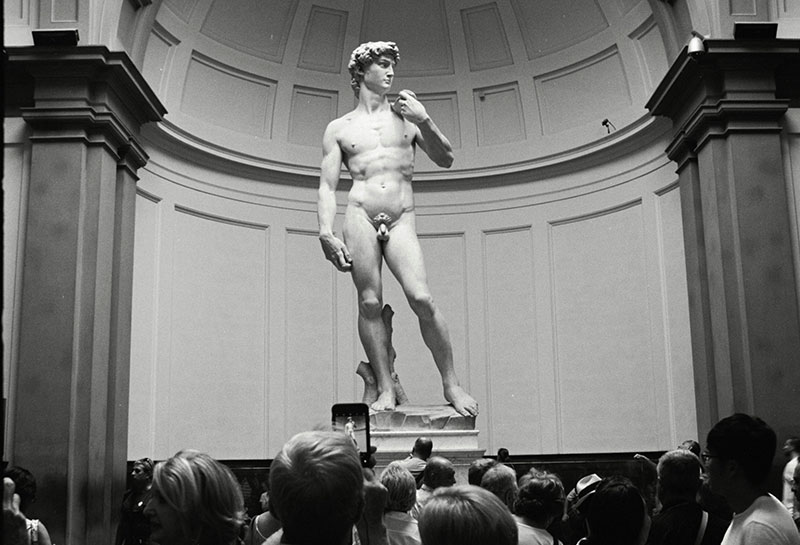
Walking through Florence feels like walking through an open-air museum where the 15th century never really ended. Photos don’t do it justice. You have to stand at his feet in the Accademia Gallery to truly grasp the sheer scale of Michelangelo’s giant.
Why does this art matter so much? Before the Renaissance (roughly the 14th to 17th centuries), medieval art was largely flat and symbolic. It was meant to inspire religious fear or awe, not to look like real life.
The Renaissance changed everything by shifting the focus to Humanism. Suddenly, artists were interested in the human experience, emotion, and the natural world. They used math to create linear perspective, giving paintings real depth. They dissected bodies to understand muscle structure.
This wasn’t just about making prettier pictures. It was a radical shift in human consciousness. It was the moment we stopped just looking up at heaven and started looking around at the world, and ourselves, with curiosity. When you look at a da Vinci or a Michelangelo, you are looking at the birth of the modern mind.
Art hits harder when the logistics are right. If you are building a first-time itinerary that actually flows, start here: The Ultimate Italy Travel Guide (2026)
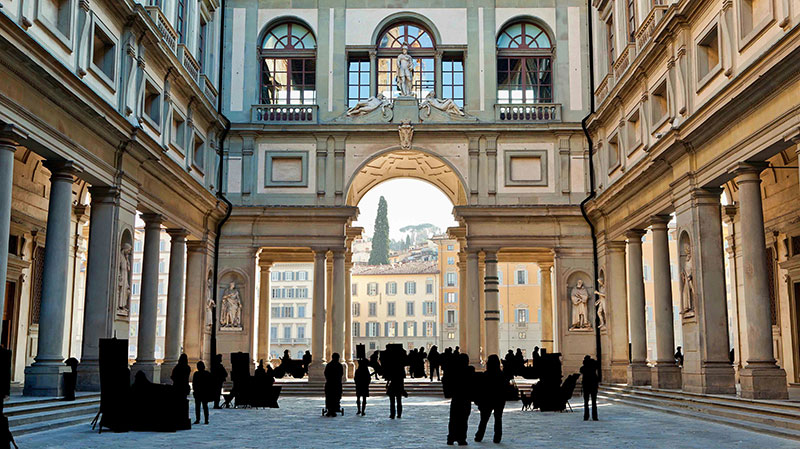
The iconic Piazzale degli Uffizi, the architectural gateway to the Uffizi Gallery’s masterpieces.
You cannot talk about Renaissance art without starting in Florence. This is where it began, fueled by the banking money of the Medici family who hired artists the way tech billionaires hire software engineers today.
The Uffizi Gallery is overwhelming, but it is essential.
Local Guide Tip: Context is Everything (Don’t Walk Alone)
When visiting a massive gallery like the Uffizi, do not just wander aimlessly. Rent the audio guide or, better yet, book a human expert.
Think of it like seeing a Jackson Pollock painting. Without context, it just looks like splattered paint that a kindergartner could do. But when you learn that he was breaking glass ceilings and reinventing the very definition of art, it becomes genius. The Renaissance is the same. These aren’t just pretty religious pictures; this was a golden era of world-changing invention. You need a guide to help you see the “glass ceilings” these artists were breaking.
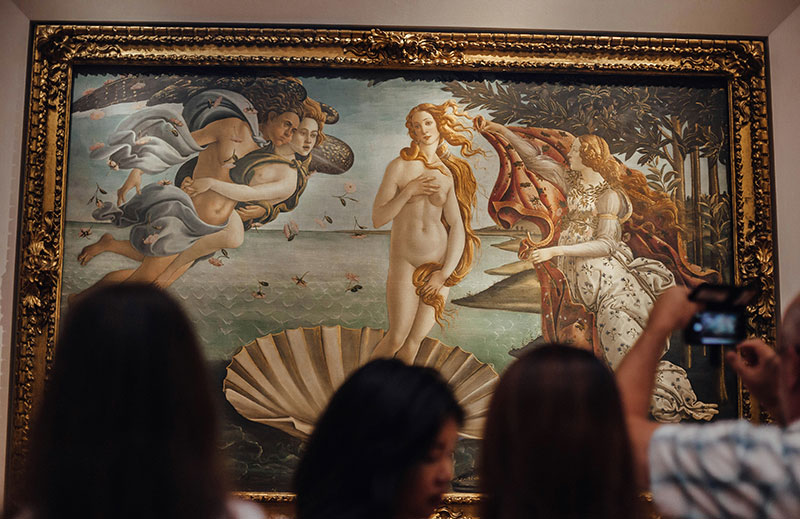
Yes, there will be a crowd, but witnessing the sheer scale and grace of Botticelli’s Venus in person is absolutely worth it.
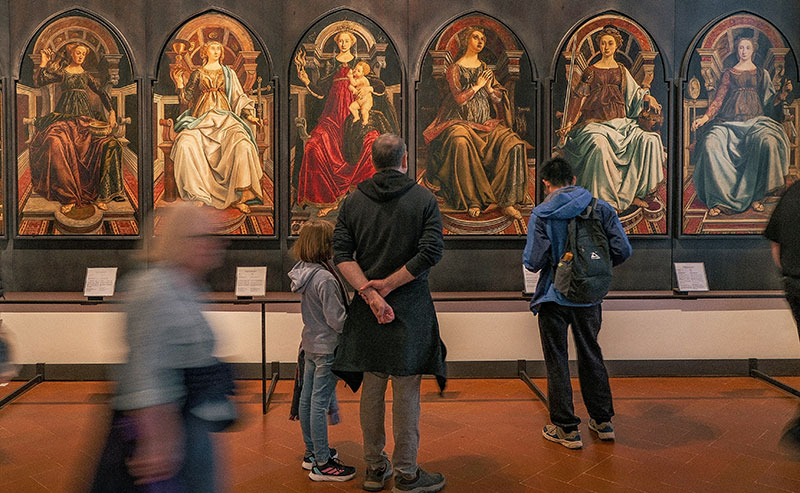
Inside the Botticelli Hall: Standing before the enigmatic Primavera, one of the most debated paintings in art history.
Booking Note: Do not even think of showing up in Florence without tickets in 2026. You need separate tickets for the two main museums.
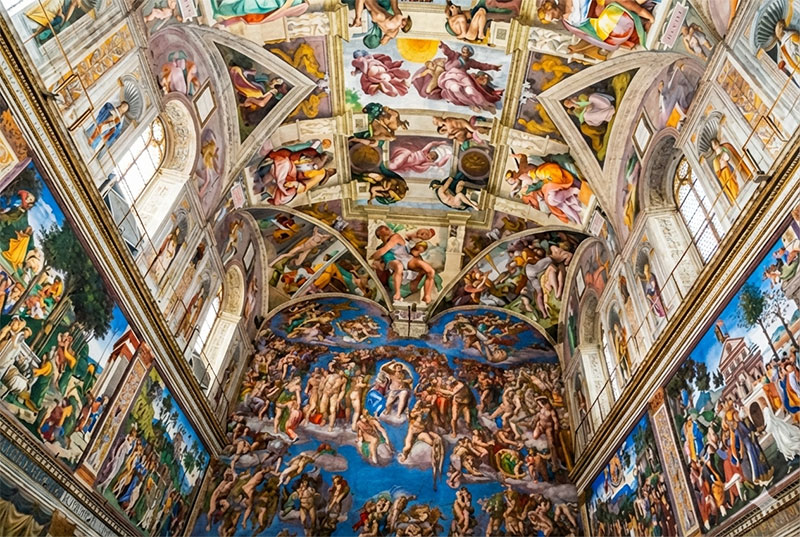
The sheer scale of the Vatican Museums is mind-boggling. It is miles of galleries leading to the ultimate prize: the Sistine Chapel. Ignore the guards yelling “No Photo!” and just look up, Michelangelo’s ceiling is even more powerful than you expect.
If Florence is where the Renaissance was born, Rome is where it grew up and got powerful. The Popes saw what was happening in Florence and used their immense wealth to bring the best artists to Rome to glorify the church.
The Vatican Museums are vast and intense. You will be shuffled along in a massive herd of people, but the rewards are worth the struggle.
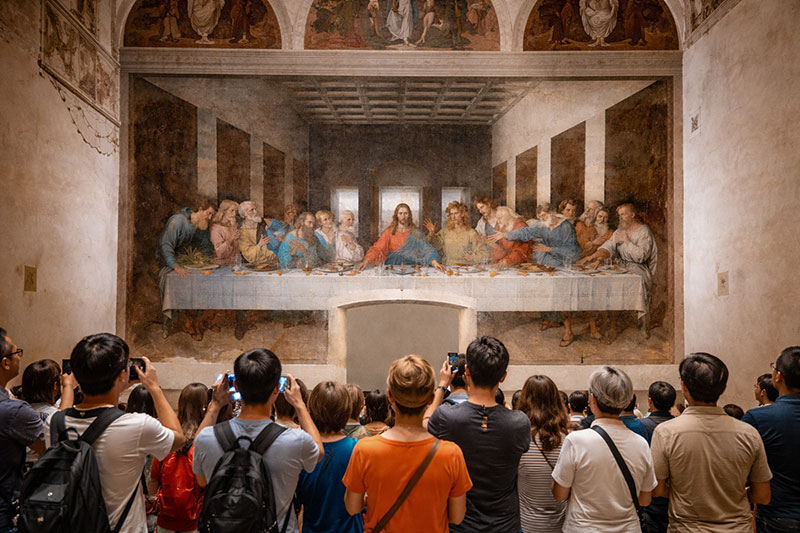
It’s faded, it’s fragile, and tickets are impossible to get, but standing before The Last Supper is still a moving testament to Leonardo’s genius.
While not on the “Big Three” route, if you are truly fascinated by Leonardo the inventor and thinker, you have to get to Milan. This is where he spent his most productive years working for the Duke of Milan.
You can see Leonardo’s original drawings primarily in Florence at the Uffizi Gallery (Gabinetto Disegni e Stampe) and in Milan at the Biblioteca Ambrosiana holding his manuscripts.
For interactive museums showcasing models of his inventions and designs, visit:
Booking Note: Tickets for The Last Supper are released quarterly and sell out in minutes.
If you love discovering places like the Ambrosiana library that most tourists miss, check out my guide to unique experiences across Italy that go beyond the standard itinerary. Read More: Italy’s Hidden Gems & Unique Experiences
If you only build museum time around a few true masterpieces, make it these. Each one is permanently housed in Italy and absolutely worth seeing in person.
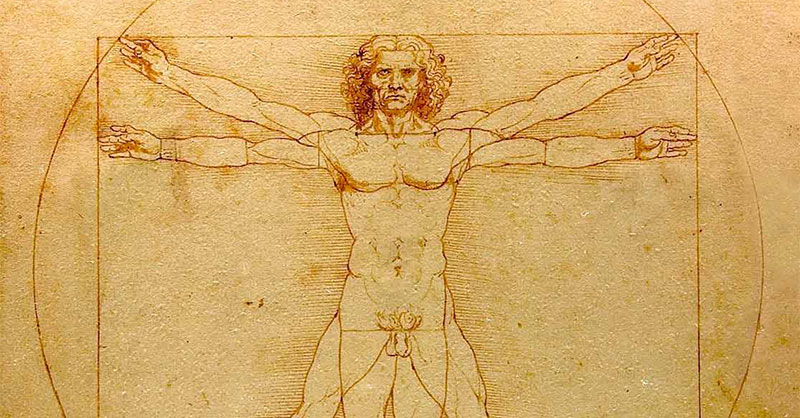
Leonardo’s iconic Vitruvian Man technically lives in Venice at the Gallerie dell’Accademia, but you likely won’t see it. Because the ancient paper is extremely sensitive to light, the drawing is kept in a dark, climate-controlled vault and is only displayed for a few weeks once every several years.
For major museums like the Uffizi, Accademia, and Vatican Museums, booking online in advance is the only way to avoid 3+ hour lines. Look for “Skip the Line” tickets on the official museum websites 2–3 months before your trip.
For pure art museums (like the Uffizi or Borghese Gallery), there is no dress code. However, for churches (St. Peter’s Basilica, the Pantheon) and museums attached to holy sites (Vatican Museums/Sistine Chapel), you must cover your shoulders and knees.
Generally, yes. Photography (without flash) is allowed in the Uffizi, Accademia, and most of the Vatican Museums. However, photography is strictly forbidden inside the Sistine Chapel and usually prohibited at The Last Supper.
The original statue of David is in the Galleria dell’Accademia in Florence. The statue standing outside in the Piazza della Signoria is a replica.