Travel Planning Hub
Start here to plan your trip, compare options, and explore every TLGA planning guide.
Packing & Gear Guide
What to pack, what to skip, and how to build a lighter travel setup that works.

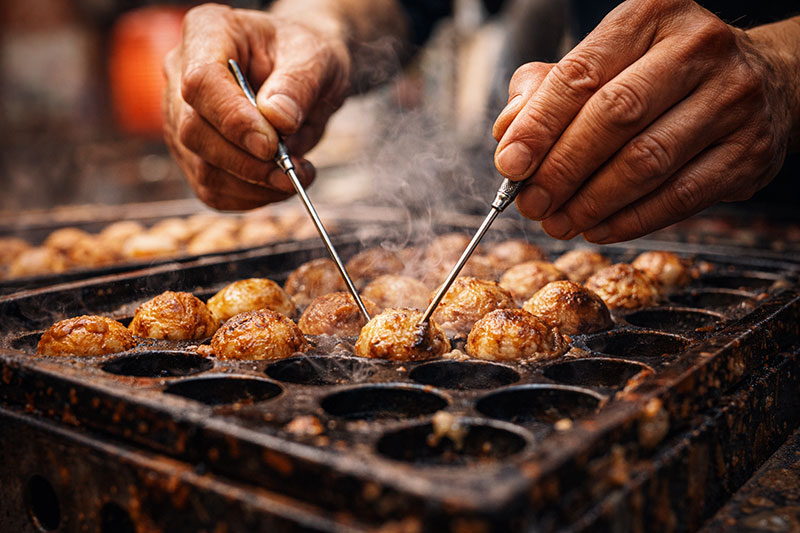
A street food vendor flips freshly cooked takoyaki by hand on a cast iron griddle, a classic Osaka street food scene.
Last updated: March 2026 by Corey Gasman
There is an old Japanese proverb: “Kyoto no kidaore, Osaka no kuidaore.” Roughly translated: “Dress until you drop in Kyoto, eat until you drop in Osaka.”
If Tokyo is the polished, futuristic brain of Japan, Osaka is its rowdy, hungry stomach. The energy here is different. People walk faster, talk louder, and take their food incredibly seriously. In 2026, the street food scene has evolved, but the core rule is still undefeated: if there is a line, get in it.
But here is the honest truth. Dotonbori can be a tourist trap if you do not know where to look. You can easily drop $50 on mediocre crab legs if you are not careful. This guide is my personal map to eating like a local in Japan’s kitchen, from the neon-soaked bridges to the retro backstreets.
Planning note: Come hungry, but come strategic. The best time to hit Dotonbori is late afternoon (around 4:00 PM) before the dinner rush, or late night (after 9:00 PM) when the day-trippers have cleared out.
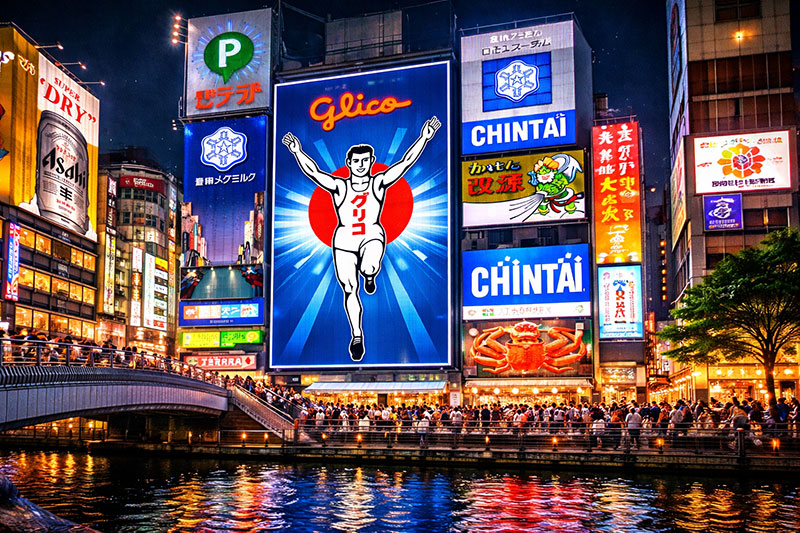
The Glico Man sign is iconic, but the real magic happens in the side streets that run parallel to the canal.
You cannot visit Osaka without eating takoyaki (octopus balls). It is the soul food of the city. In 2026, you will even spot robot-operated stalls, but I still urge you to stick to the humans. Watching a master flip 50 balls with two metal picks at lightning speed is part of the price of admission.
Skip the monster lines directly under the Don Quijote Ferris wheel. Instead, head to Takoyaki Wanaka near Namba Grand Kagetsu. The outside is crisp, the inside is molten hot (be careful), and the dashi flavor is noticeably better than the tourist heavy hitters.
Local Guide Tip: The “O-Kar” Choice
When ordering takoyaki, you will often be asked about toppings. Standard is sauce and mayo. The pro move is “Ponzu” (citrus soy sauce) or simply “Shio” (salt). Salt-only lets you taste the batter and the octopus without drowning it in heavy sauce. Locals use this to tell a great shop from an average one.
Osaka-style okonomiyaki mixes everything into the batter before grilling. For the best experience, pick a place where they cook it on the iron griddle (teppan) right in front of you.
Mizuno is famous for a reason (their Yamaimo-yaki uses yam flour instead of wheat for a fluffier texture), but the line can hit 90 minutes. If you want to skip the wait, look up. The upper floors of nearby buildings often hide smaller, family-run shops with great teppan skills and a fraction of the crowd.
Pro Tip: Do not cut okonomiyaki like a pizza. Use your small spatula (kote) to score a grid of squares. It is easier to grab with chopsticks.
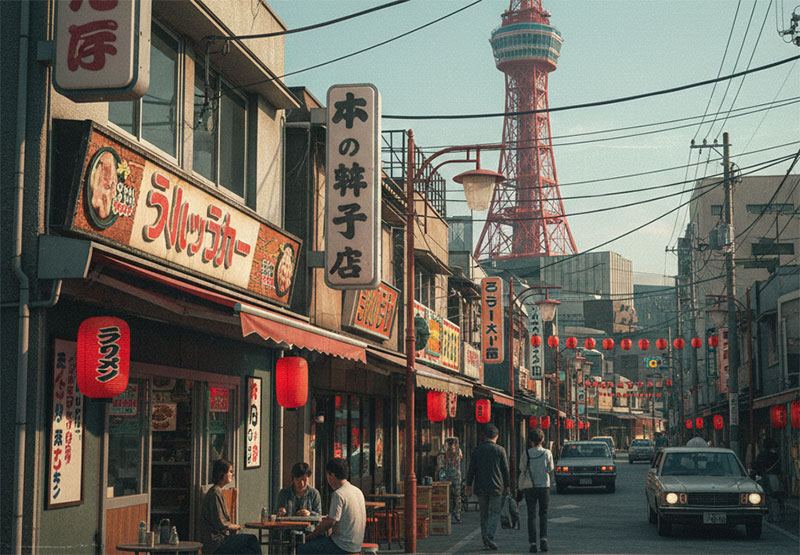
Shinsekai feels like a movie set from the 1960s. It is gritty, retro, and smells like frying oil in the best possible way.
Shinsekai (New World) is my favorite neighborhood in Osaka. It was “futuristic” in 1912, and now it is a neon-lit time capsule with zero interest in pretending it is polished. This is the home of kushikatsu, skewers of meat, veggies, and cheese, breaded and deep-fried.
Kushikatsu Daruma is the famous chain (look for the angry chef statue), but the smaller stalls in Janjan Yokocho alley often have more character. Order lotus root (renkon), red ginger (beni shoga), and beef, then keep going until you accidentally over-order and have no regrets.
Local Guide Tip: The “No Double Dipping” rule used to be strict back when communal sauce pots were standard. In 2026, many shops use squeeze bottles for hygiene, but the spirit remains the same. Respect the sauce, and do not be that person.
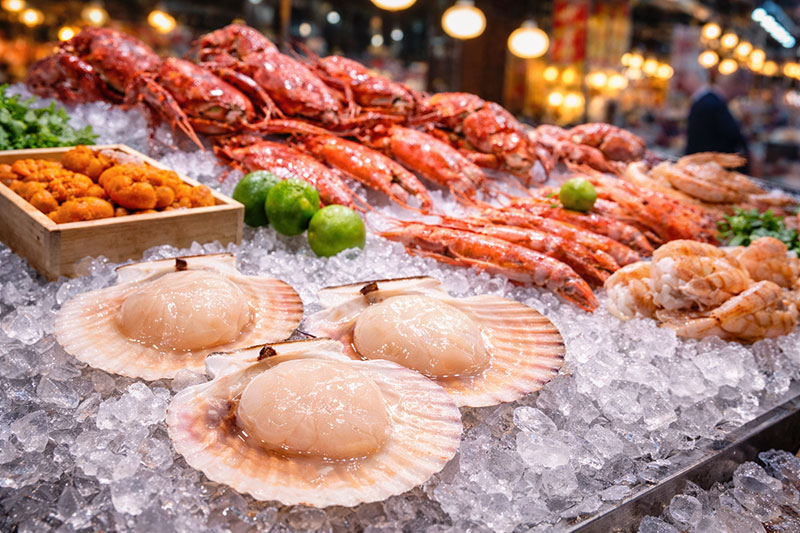
Kuromon Market offers incredible seafood, but price tags can be shocking. Navigate with caution.
Kuromon Market is known as “Osaka’s Kitchen.” Visually, it is stunning. Giant raw scallops on ice, glossy sashimi cuts, grilled unagi, and premium wagyu displays fill the narrow arcade.
But in recent years, prices have climbed hard to target tourists. You might see a single crab leg for ¥3,000 (about $20 USD). It is tasty, but it is absolutely a markup moment.
My advice: Go for the atmosphere and a few snacks, then save your full meal for elsewhere. The grilled scallops and oden (simmered broth dishes) are usually better value than wagyu skewers or king crab.
Pro Tip: Visit early (around 9:00 AM) to beat the crush. By 11:00 AM, it can turn into shoulder-to-shoulder traffic.
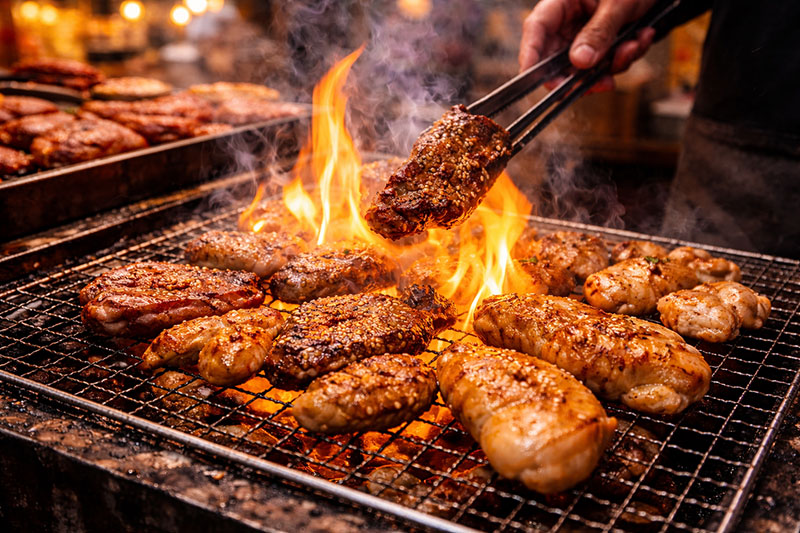
Stepping off the train at Tsuruhashi, you get hit with sesame oil and grilling meat. It is intoxicating.
If you want to escape the main tourist loop, hop on the JR Loop Line to Tsuruhashi. This is Osaka’s Koreatown, and it might be the best dinner neighborhood in the city.
The area is a labyrinth of yakiniku (Japanese BBQ) restaurants. The meat quality is excellent and often cheaper than Namba. Look for “Sora” if you are adventurous (known for offal, also called horumon), or follow the simplest rule in Japan: pick the place with a line of locals.
Local Guide Tip: Wear clothes you can wash. Ventilation in Tsuruhashi restaurants is “authentic,” which means you will leave smelling like delicious grilled beef.
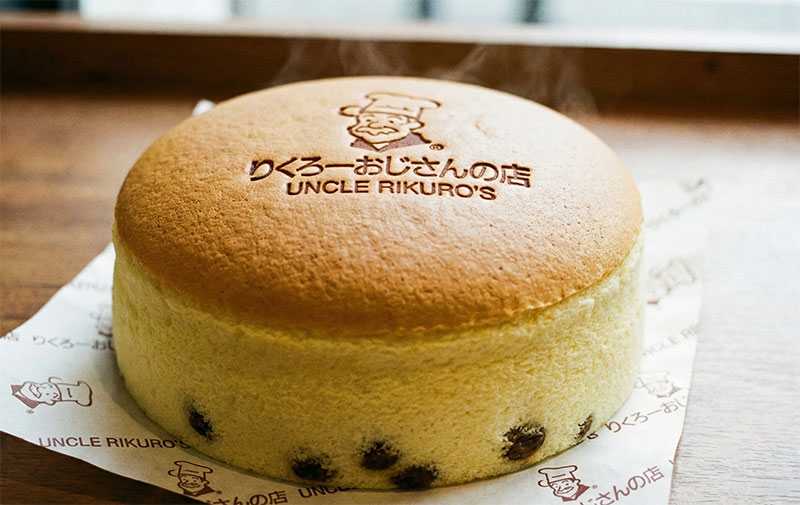
The jiggle is real. Rikuro’s cheesecake eats more like a soufflé than a New York cheesecake.
Osaka takes dessert seriously. Two must-tries:
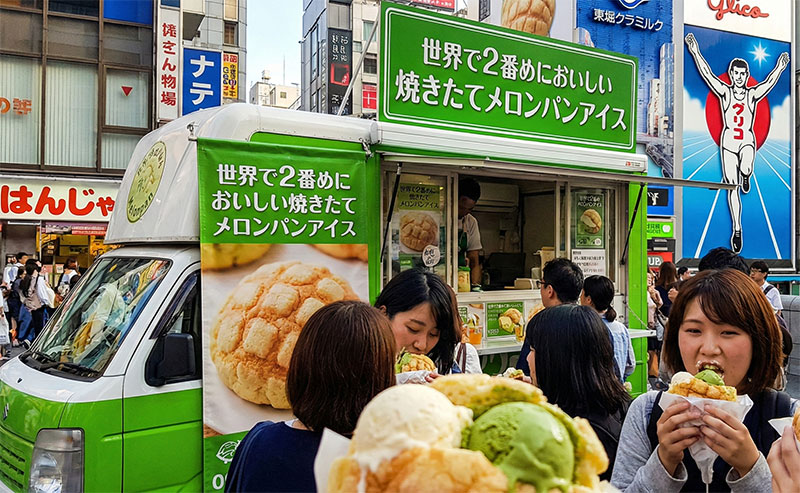
A must-try street food in Osaka! The famous “World’s Second Best Melonpan” food truck in Dotonbori serves up warm, crispy melonpan filled with cold, creamy matcha or vanilla ice cream. It’s a delicious, messy, and perfect treat while exploring the city.
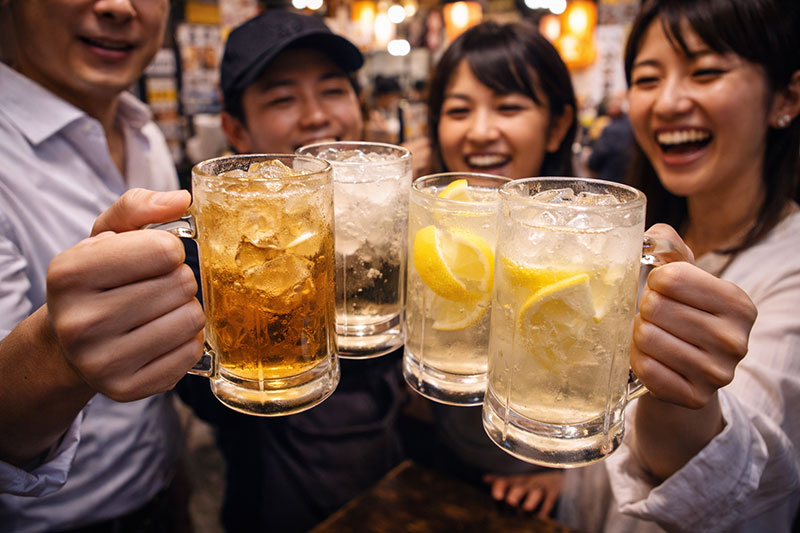
Locals and travelers share highballs and craft lemon sours at a bustling tachinomi, Osaka’s casual standing-bar tradition.
Osaka is highball territory (whisky and soda), and it pairs perfectly with greasy, savory street food. In 2026, craft lemon sours are also having a huge moment, especially in the livelier bar pockets around Namba.
To drink like a local, find a tachinomi (standing bar). These are small, casual spots where you stand at the counter, order a couple small dishes, and drink cheap booze. It is about as social as you will find Japan, and Osaka does it best.
Pro Tip: “Sumimasen!” (Excuse me!) is the magic word. In a loud Osaka bar, you often have to say it with confidence to get service. Do not be shy.
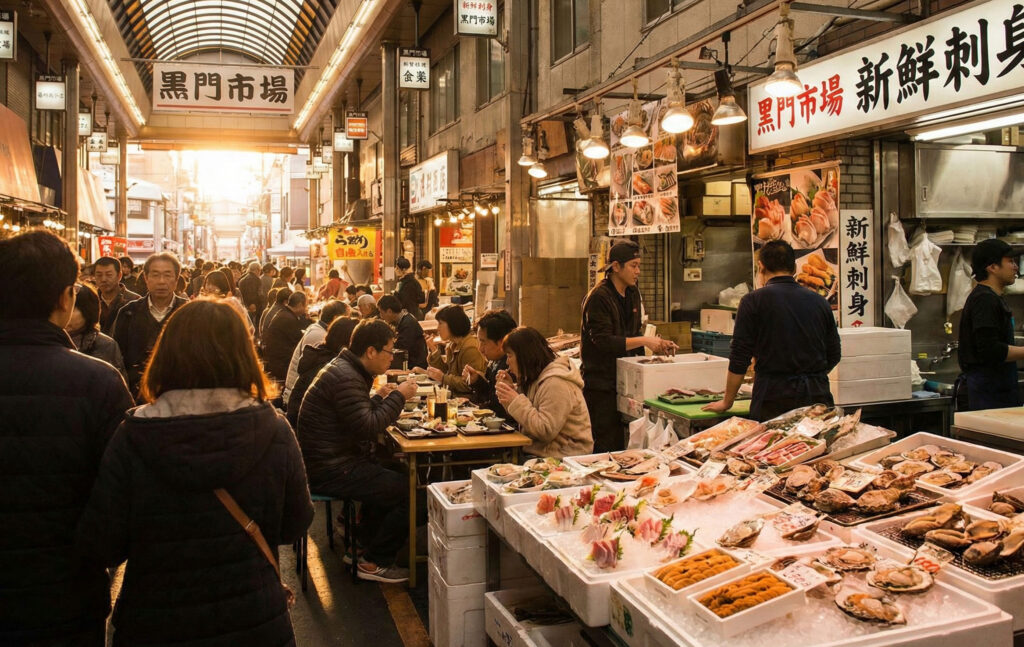
The “Kitchen of Osaka” glowing in the late afternoon light. Fresh sashimi and seafood bowls line the stalls of Kuromon Market, offering the perfect snack while exploring the city at golden hour.
If you only have one night in Osaka, this is the exact path I take friends on. It balances the tourist “must-sees” with the hidden local haunts, all while keeping the walking manageable.
4:00 PM | The Retro Kickoff (Shinsekai)
Start at Tsutenkaku Tower. Grab a light snack of 3-4 skewers of Kushikatsu at a standing stall in Janjan Yokocho. It’s early enough that you won’t have to fight for a spot.
5:30 PM | The Market Wander (Kuromon)
Walk 15 minutes north to Kuromon Market. Most stalls start closing at 6:00 PM, which is the “Golden Hour” for discounts. Look for pre-packed sashimi or grilled scallops that are marked down for quick sale.
6:30 PM | The Hidden Alley (Hozenji Yokocho)
Head toward Namba and duck into Hozenji Yokocho. This stone-paved alley feels like old Kyoto. Visit the moss-covered Buddha at Hozenji Temple, then grab Okonomiyaki at a small shop nearby.
8:00 PM | The Neon Finale (Dotonbori)
Walk two minutes to the Dotonbori Canal. Take your “Glico Man” selfie, then hunt for the Takoyaki Wanaka stall mentioned above. End your night with a Highball at a nearby Tachinomi (standing bar) while watching the crowds.
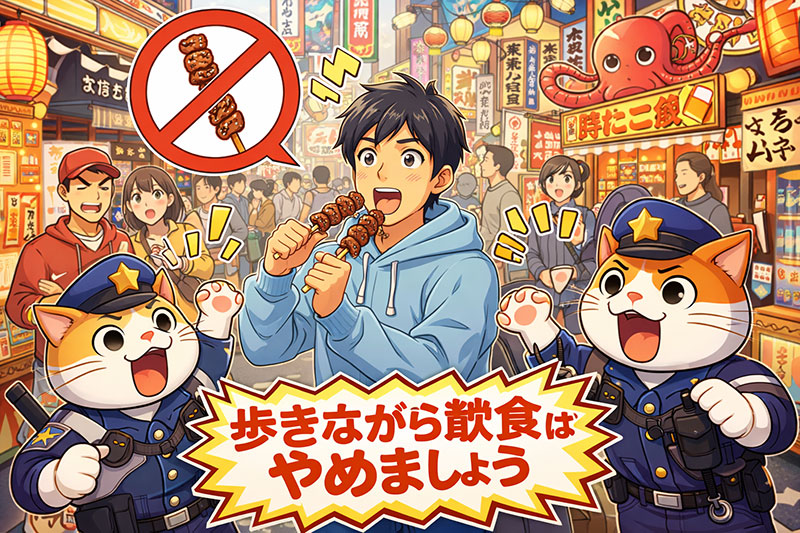
A playful anime-style illustration in Osaka humorously reminds visitors not to eat meat skewers while walking through busy street food areas. Translation: “Please don’t eat while walking.”
Even in rowdy Osaka, rules apply. The biggest mistake tourists make is walking while eating.
In Japan, “eating on the go” usually means buying food, standing near the stall (or at a designated bench), finishing it, and tossing trash in the stall’s bin. Do not walk down a crowded street with a skewer in your hand. It is considered rude, and it can be genuinely dangerous in tight crowds.
Mostly, yes. PayPay and contactless cards are widely accepted now. That said, older stalls and some ticket machines (especially for ramen) can still be cash-only. Carry around ¥5,000 just in case.
Incredibly safe. Japan’s hygiene standards are world-class. You can even find raw chicken (torisashi) at reputable izakayas, though if you have a sensitive stomach, stick to cooked options and you will be very happy here.
You can get very full in Osaka for ¥3,000 to ¥4,000 (about $20 to $25 USD). Takoyaki is often around ¥700. A kushikatsu skewer can be ¥150. A beer is commonly ¥500. It is usually cheaper than Tokyo for the same level of satisfaction.