Travel Planning Hub
Start here to plan your trip, compare options, and explore every TLGA planning guide.
Packing & Gear Guide
What to pack, what to skip, and how to build a lighter travel setup that works.

By Corey Gasman
In many countries, walking into a restaurant alone and saying “table for one” can feel like a spotlight you never asked for. You scroll your phone to look busy. You eat fast. You wonder if everyone is clocking you.
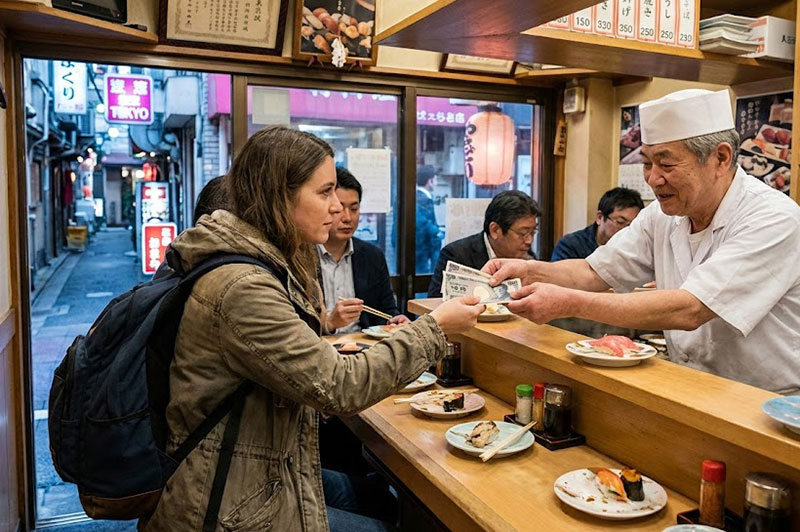
Japan is different. It might be the only place on earth where solo dining is not just accepted, it is engineered. Here, the “solo diner” (ohitorisama) is a respected customer. Restaurants are built around counters, single booths, and ordering systems that let you eat extremely well with zero social friction.
Some of my best meals in Japan have not been loud group dinners. They have been quiet bowls of ramen at a counter, watching the chef work, totally lost in the steam and the flavor. If you are traveling solo, do not default to convenience-store meals every night. The best food in the country is waiting for you, and you can walk right in.
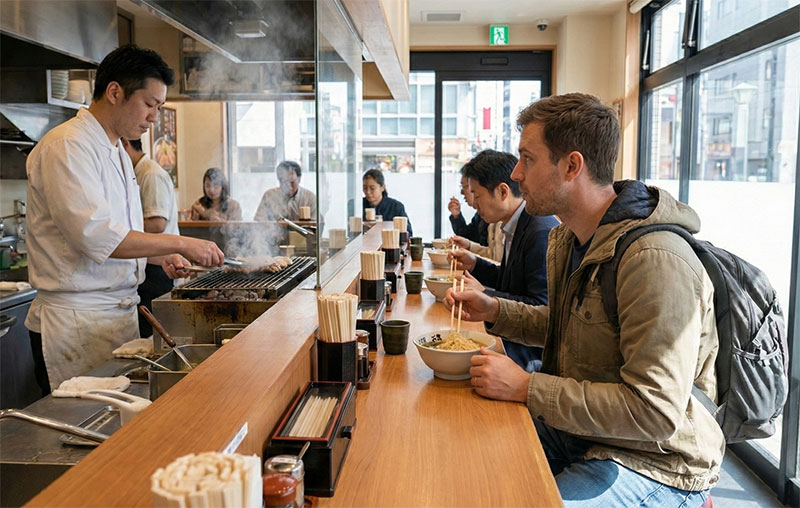
Counter seating is not the “bad” section in Japan. It is the front row, and the kitchen is the stage.
In the West, the bar is for drinking. In Japan, the counter is for eating. Almost every restaurant, from high-end sushi to tiny curry shops, has a long counter facing the open kitchen.
That setup is a gift to solo travelers. Instead of staring at an empty chair across from you, you get something better: motion, craft, and focus. You watch the chef slice sashimi, grill yakitori, torch a piece of fish, or lift noodles from boiling water like it is choreography.
Local Guide Tip: “One person” in Japanese
When you enter, staff may ask “Nan-mei sama?” (How many people?).
Just respond with “Hitori desu”, which means “one person.” Staff will usually point you straight to a counter seat.
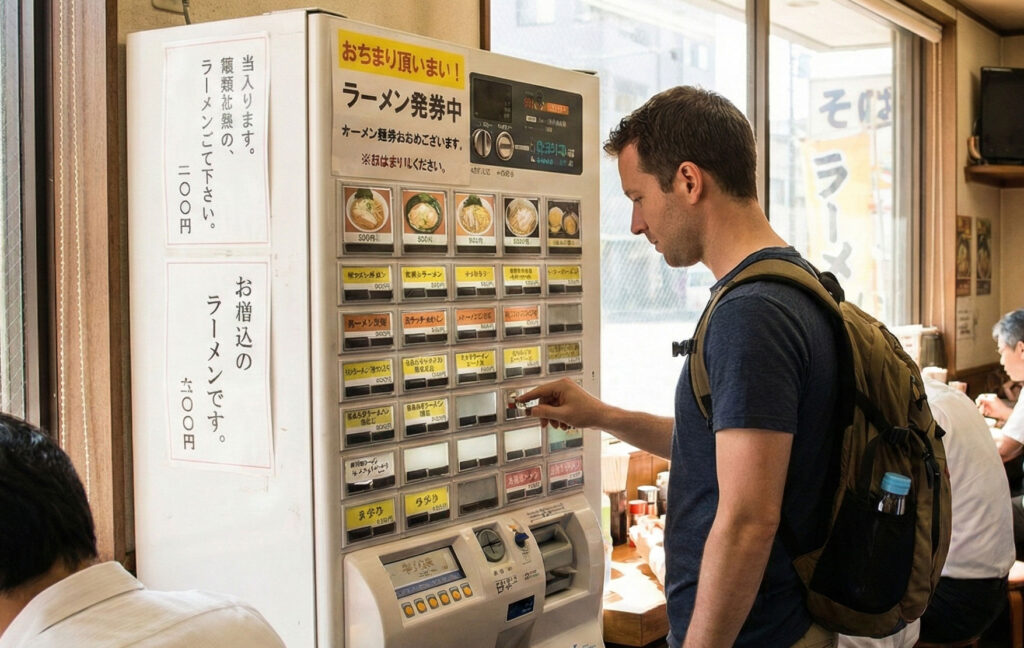
The ticket machine is the ultimate anxiety-killer: choose, pay, hand over the ticket, eat well.
For many solo travelers, the real fear is not eating alone. It is ordering wrong, slowing the line, or freezing up because the menu looks like a wall of kanji.
Enter the shokkenki (meal ticket machine). Found at the entrance of many ramen, soba, udon, and beef-bowl spots, it lets you choose your meal, pay, and receive a ticket before you sit down. Minimal talking. Maximum efficiency.
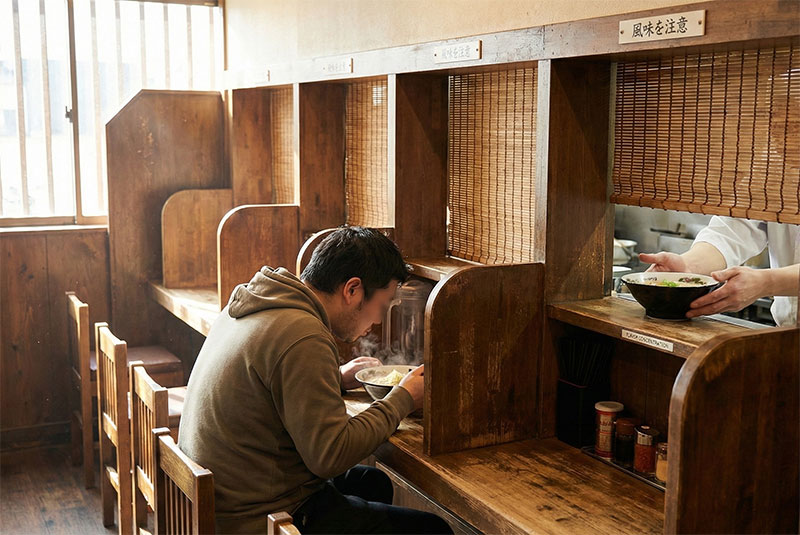
Ichiran’s “Flavor Concentration Booths” are extreme, but they prove how seriously Japan takes solo dining.
Ramen is a fast sport. You slurp, you eat, you leave. It is rarely a social event, and that is exactly why it is perfect when you are traveling alone.
Ichiran Ramen is famous for its “Flavor Concentration Booths”, individual cubicles with partitions and a bamboo curtain in front. You can complete the entire meal with almost no interaction. It is the most introvert-friendly dining experience on earth.
But do not be afraid of normal ramen shops either. Walking into a loud, steamy room, tucking into a counter seat, and watching bowls fly out of the kitchen is a quintessential Tokyo moment.
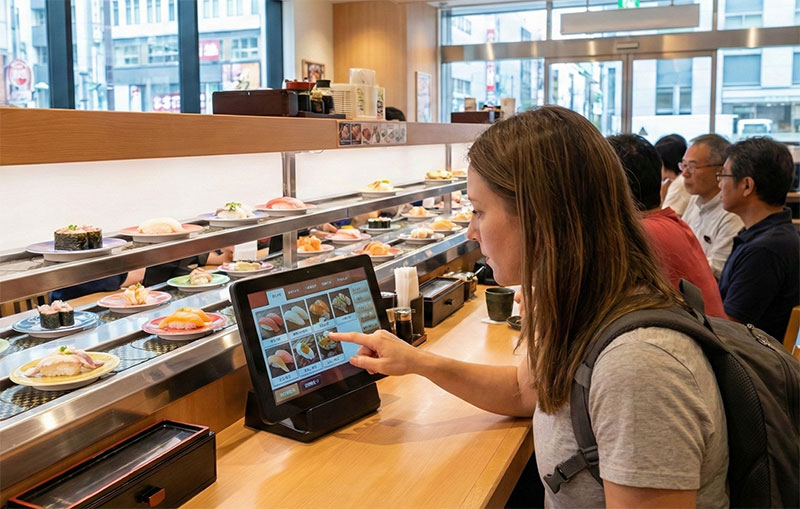
Conveyor belt sushi is solo-dining perfection: you control the pace, the price, and the portions.
If you are solo, a high-end sushi counter can feel intimidating. Kaitenzushi is the stress-free alternative that still tastes great.
You sit down, tap what you want on a screen, and plates zoom to your seat on a belt (or a mini express lane). Chains like Sushiro, Kura Sushi, and Uobei are foreigner-friendly with English menus. You can eat 5 plates or 20, spend $10 or $30, and leave whenever you want.
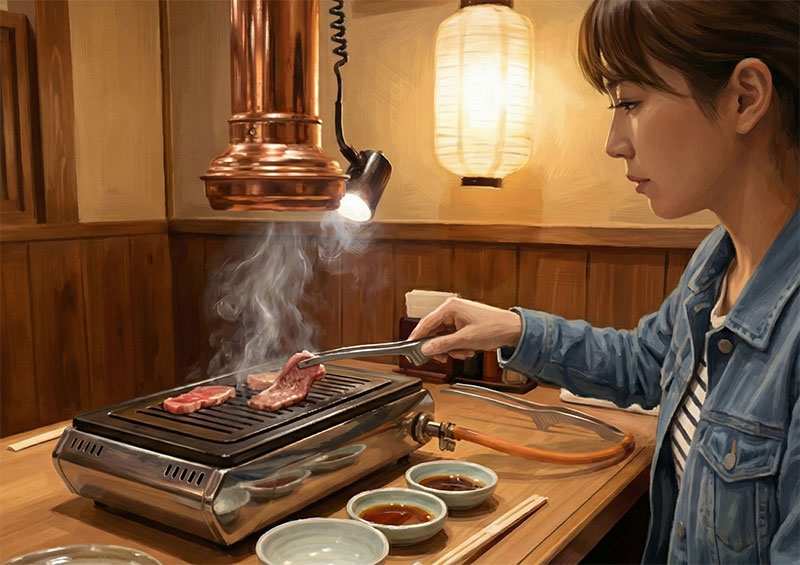
“Yakiniku Like” is built for one: your own mini grill, sauce tray, and zero judgment.
Yakiniku used to be a group activity. Not anymore. A chain called Yakiniku Like popularized “solo yakiniku” with single booths and personal mini-grills.
You get a set meal of beef, rice, and soup, and you cook a few slices at a time right in front of you. It is fast, affordable, and the cleanest way to scratch that wagyu itch without needing a crew.
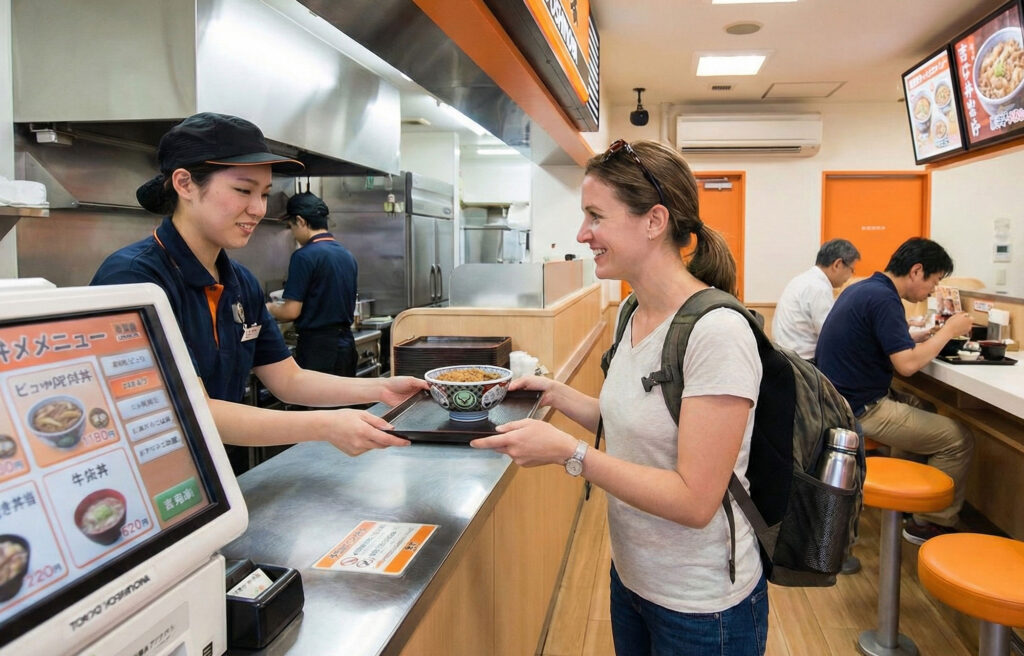
Yoshinoya, Sukiya, and Matsuya: bright signs, fast food, and some of the best quick solo meals in Japan.
If you are exhausted, hungry, and just want food now, look for the brightly colored signs of Yoshinoya, Sukiya, or Matsuya.
These are gyudon (beef bowl) chains. Many are open late, some are 24/7, and solo diners make up a huge share of the crowd. The food is simple and comforting: thin beef and onions over rice, with optional upgrades like a raw egg, kimchi, or extra scallions. It is cheap, fast, and oddly satisfying.
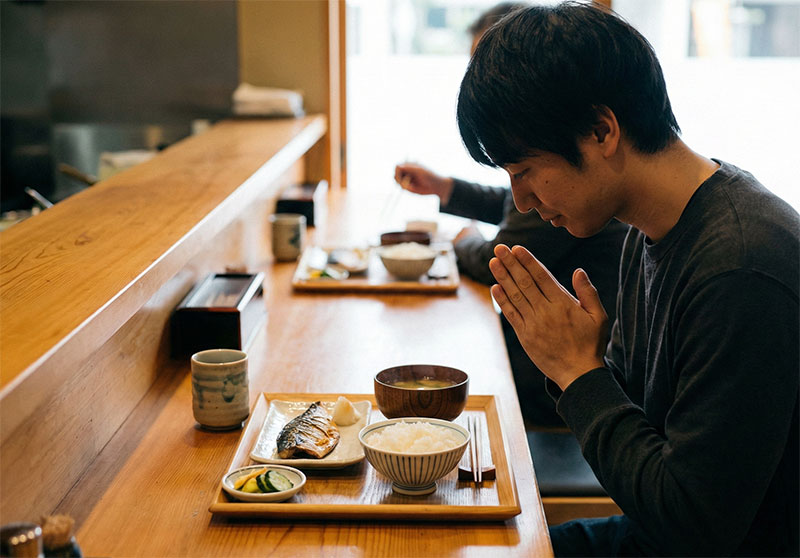
A quiet moment of gratitude: saying “Itadakimasu” before digging in is the first step of Japanese dining etiquette.
Eating alone does not mean you are invisible. A few small habits help you blend in, and they genuinely improve the vibe of the meal.
Absolutely not. While some beef-bowl spots can be male-heavy, you will see women eating alone everywhere: cafes, sushi, ramen, family restaurants, and bakeries. It is normal, common, and generally very safe.
Yes. Aim for the counter. The taisho (owner-chef) might even chat with you if the place is relaxed. Start with a drink and a couple small plates like yakitori or edamame, and build from there.
No shame in a konbini picnic. Grab onigiri, a salad, a hot snack, and dessert from 7-Eleven, Lawson, or FamilyMart and eat in your room. We have all done it, and sometimes it is exactly what you need.