Travel Planning Hub
Start here to plan your trip, compare options, and explore every TLGA planning guide.
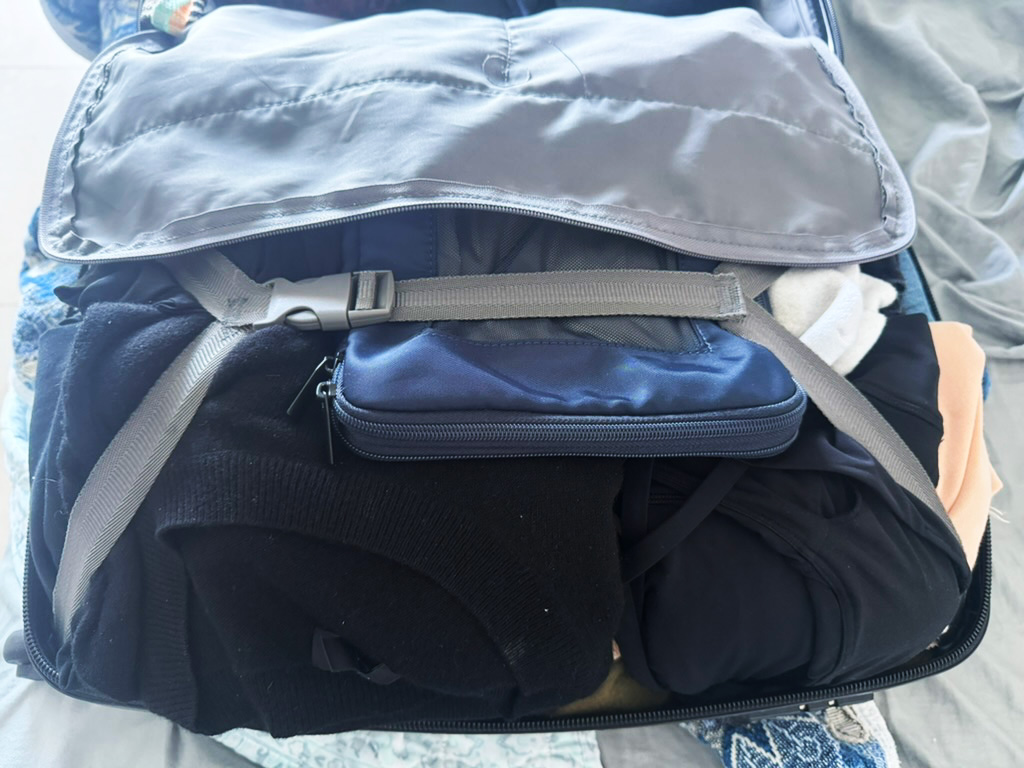
Packing & Gear Guide
What to pack, what to skip, and how to build a lighter travel setup that works.
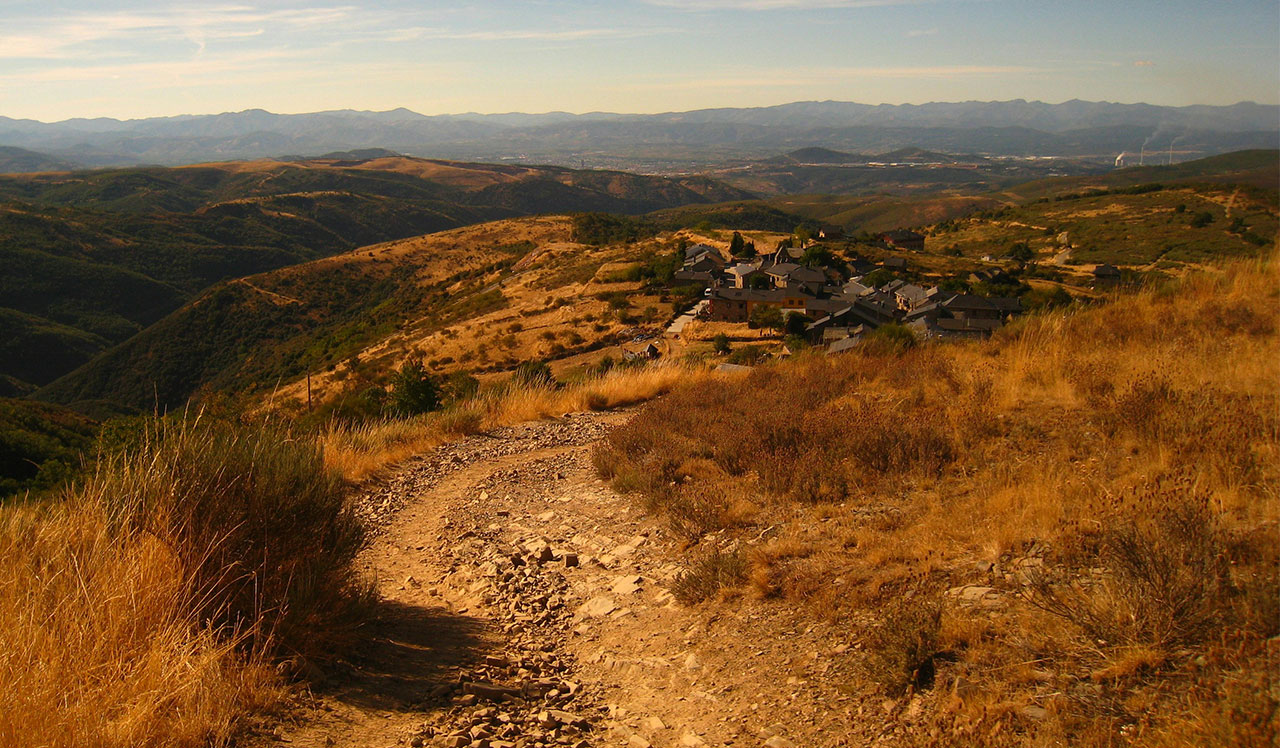
The Camino is not one trail but a network of pilgrimage routes across Spain and Portugal, and the best first trip is usually a partial walk, not the full marathon.
Last updated: March 2026 by Corey Gasman
From the Editor
The Camino de Santiago is one of those trips that pulls people in for different reasons. Some come for the spiritual history, some for the physical challenge, and plenty just want a slower, more meaningful way to experience Spain. What makes it special is that it strips travel down to the basics. Wake up, walk, eat, rest, repeat.
It can also feel intimidating from a distance. The word pilgrimage sounds big. The idea of walking day after day can make you wonder if the Camino is only for serious hikers, lifelong walkers, or people with weeks to spare. It is not. The Camino can be shaped around your time, your body, your pace, and the version of the trip that actually feels right for you.
You do not need to hike the full route from France to Santiago to have a real Camino experience. In fact, for most first-timers, walking a shorter section is the smartest move. You still get the small towns, pilgrim hostels, trail rituals, shared meals, yellow arrows, quiet mornings, and that satisfying arrival into Santiago, just without needing five or six weeks off.
This guide focuses on the practical side of the Camino, but also the reason people keep talking about it long after they come home. If the spirit moves you, the Camino has a way of meeting you where you are. Some days will test your legs and patience. Other days will feel almost effortless. By the end, the reward is not just reaching Santiago. It is realizing you carried yourself there one step, one town, and one day at a time.
Planning a bigger Spain trip?
The Camino is one of the best slow-travel experiences in Spain, but it is even better when you understand how it fits into a broader Spain itinerary. Browse my full Spain Travel Guide for regional ideas, logistics, food, and more trip planning help. It is a good starting point if you want to connect your walk with extra time in places like Madrid, Galicia, the Basque Country, or Andalusia.
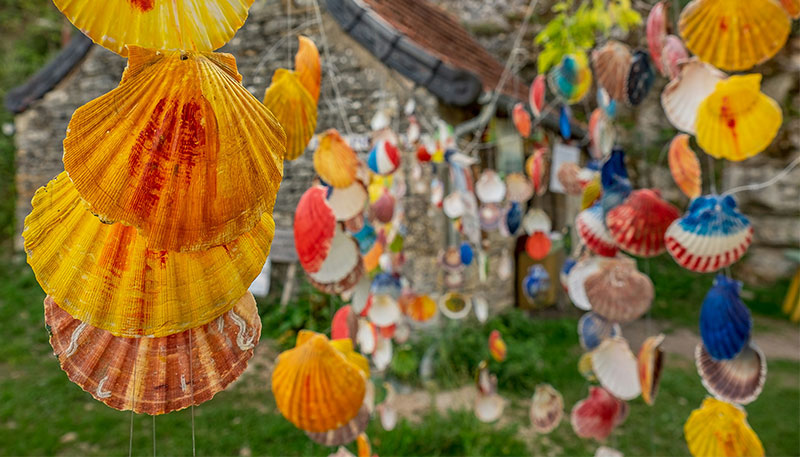
The scallop shell is the universal symbol of the Camino, guiding pilgrims and marking trails, backpacks, and towns along the route.
The Camino de Santiago is a historic pilgrimage network leading to the cathedral in Santiago de Compostela in Galicia, Spain. It is not one single trail. Instead, it is a web of routes crossing Spain and Portugal, with some beginning even farther across Europe.
For modern travelers, the Camino works as both a cultural journey and a long-distance walking trip. You can tackle a full route over several weeks, or simply walk a shorter section and still get the classic pilgrim experience.
This guide is designed for first-time Camino walkers who want a practical overview before planning their trip. It focuses on the most popular routes, how long the Camino takes, what to pack, what the food is like, and how to walk a shorter section like the final 100 km into Santiago de Compostela.
Route note: This guide focuses mainly on the Spanish Camino experience, especially the popular final 100 km from Sarria to Santiago. It is designed for first-time walkers who want a practical, manageable way to experience the Camino without committing to the full route from France.
The appeal is simple. The Camino combines movement, small-town Spain, low-key social connection, and a built-in daily purpose. You do not need to overplan every hour. You just need a route, a place to sleep, and enough energy to keep moving west.
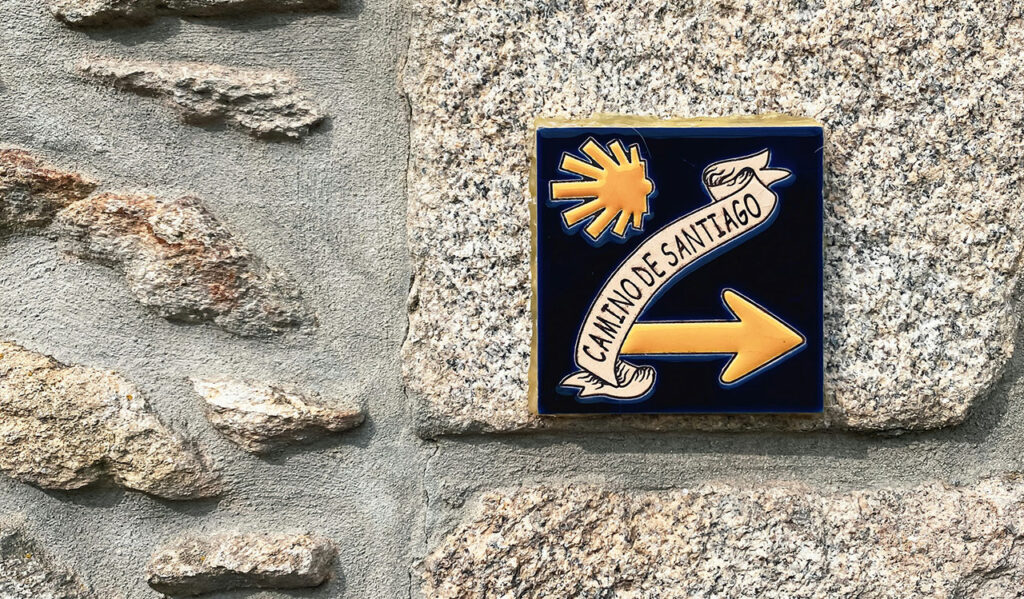
You rarely need a map on the Camino. Iconic yellow arrows and scallop shells mark the route and keep pilgrims on track.
The best Camino route depends on how much time you have, what kind of scenery you want, and whether you care about earning the official pilgrim certificate. For most first-timers, the sweet spot is choosing a route that feels achievable rather than trying to force the biggest possible version of the trip into a limited schedule.
The Camino de Santiago is not one single trail but a network of historic pilgrimage routes that lead across Spain and Portugal to Santiago de Compostela. Each route has its own personality, scenery, and level of difficulty, from the classic Camino Francés crossing northern Spain to the Atlantic-facing routes starting in Portugal.
For a first Camino, the goal is not to prove anything. The goal is to choose a route that gives you enough time to settle into the rhythm, enough support to feel comfortable, and enough challenge to make the arrival feel earned.
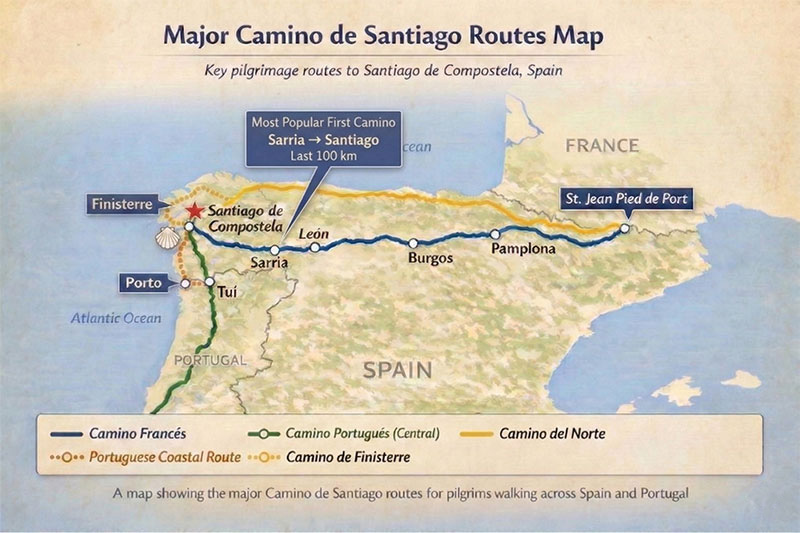
Overview map of the major Camino de Santiago pilgrimage routes across northern Spain and Portugal, including the Camino Francés, Camino Portugués, Camino del Norte, and the route from Santiago to Finisterre.
Before diving into the individual routes, it helps to visualize how the Camino network actually works. The Camino de Santiago is not one single trail but a system of historic pilgrimage routes across Spain and Portugal, all leading to the cathedral in Santiago de Compostela.
The map below highlights the most important routes travelers consider when planning their first Camino, including the classic Camino Francés, the Portuguese routes from Porto, the northern Camino del Norte, and the short extension from Santiago to Finisterre.
| Route | Distance | Typical Time | Why People Choose It |
|---|---|---|---|
| Camino Francés | About 800 km | 4 to 6 weeks | The classic route with the most history, towns, and pilgrim energy |
| Camino Portugués Central | About 240 km from Porto | 10 to 14 days | A great shorter option with Portuguese and Galician highlights |
| Portuguese Coastal Route | About 280 km from Porto | 12 to 15 days | Atlantic views, seafood towns, and a less traditional but scenic feel |
| Sarria to Santiago | About 115 km | 5 to 6 days | The most popular short walk and enough to qualify for the Compostela |
If you want to explore towns, stages, and key stops in more detail, the interactive map below shows many of the main Camino routes and planning points used by modern pilgrims.
Interactive Camino planning map showing major pilgrimage routes, towns, and key stops along the Camino de Santiago.
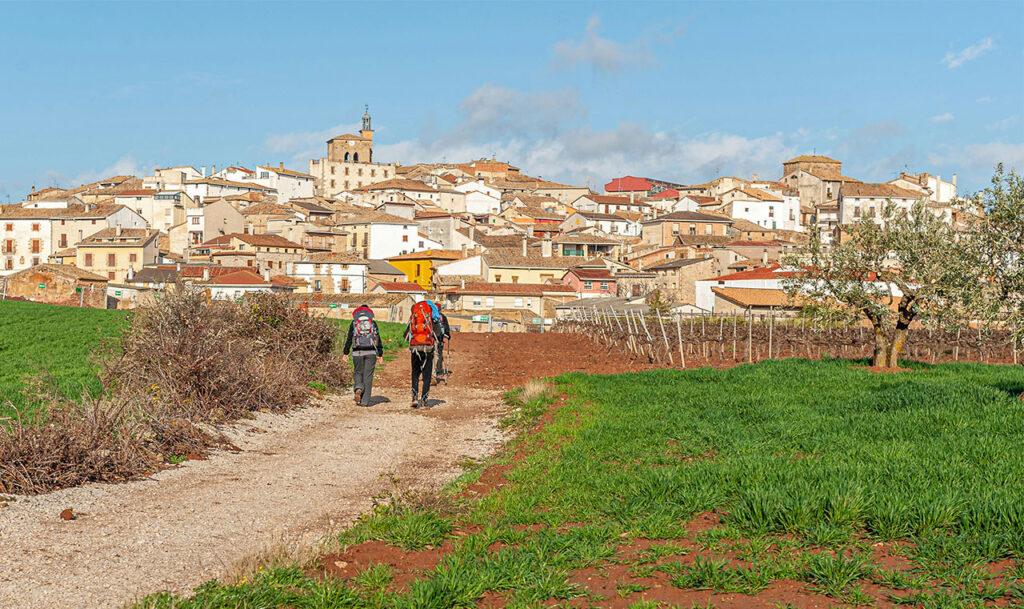
The daily rhythm of the Camino is marked by long stretches of rural paths that eventually lead to beautiful, historic hilltop towns.
If you only have a week, the stretch from Sarria to Santiago is usually the smartest first Camino. It gives you enough days to settle into the rhythm, enough infrastructure to keep things simple, and enough distance to qualify for the official Compostela certificate.
This is also the section that makes the Camino feel possible for a lot of people. You do not need to be a professional hiker or take a month off work. You need a realistic plan, comfortable shoes, a light pack, and a willingness to take the days as they come.
Why this section works
TLGA Rule: For your first Camino, choose the version you can actually enjoy. A shorter section, lighter pack, and comfortable pace will usually make the walk more meaningful than trying to cover too much too fast.
If you are walking the last 100 km, Sarria is your starting line. Getting there requires a little planning, but the transport connections in Spain are generally excellent.
If this is your first Camino, build in a little breathing room before your first walking day. Arriving tired, rushed, or jet-lagged makes the first stage harder than it needs to be. A quiet arrival day in Sarria can help you organize your pack, pick up any last-minute supplies, and start the walk with a better headspace.
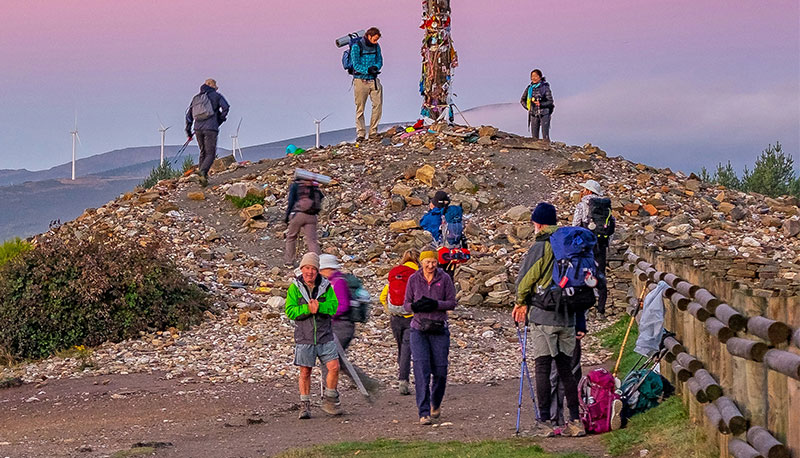
Early mornings on the trail often lead to powerful milestones, like leaving a stone at the Cruz de Ferro on the Camino Francés.
For most people, the best overall months are April to May and September to October. These windows usually bring milder temperatures and more comfortable walking conditions than peak summer.
The Camino is doable in different seasons, but your experience changes a lot depending on weather, daylight, crowds, and how many services are open. First-time walkers usually have the best experience when the days are comfortable enough to enjoy the walking and social enough to feel the Camino energy.
| Season | Best For | Watch Outs | TLGA Take |
|---|---|---|---|
| April to May | Cooler weather, green landscapes, strong walking conditions | Some rain and cooler mornings | Best first-timer window |
| June to August | Long days and fully open services | Hot stretches and bigger crowds | Doable, but start early |
| September to October | Comfortable temperatures and harvest-season atmosphere | Shorter daylight and more weather variability later on | Excellent overall balance |
| Winter | Quiet trails and reflective vibe | Cold weather and fewer open albergues | Better for experienced walkers |
The full Camino Francés takes most people around five weeks, but that is not the standard you need to chase. Plenty of travelers do a section and still have a meaningful experience.
That is one of the best things about the Camino. It gives you room to choose your own version. A five-day walk can still be powerful. A two-week route can feel like a major reset. A full route can become a life marker. The right amount of time is the amount you can walk with enough energy left to enjoy the experience.
| Trip Length | Best Approach | TLGA Recommendation |
|---|---|---|
| 5 to 6 days | Walk Sarria to Santiago | Best short Camino option |
| 7 to 10 days | Longer section of the Portuguese Way or French Way | Great for first-timers who want more trail time |
| 2 weeks | Porto to Santiago or a deeper route section | Best balance of challenge and reward |
| 4 to 6 weeks | Full Camino Francés | For travelers with real time and strong walking stamina |
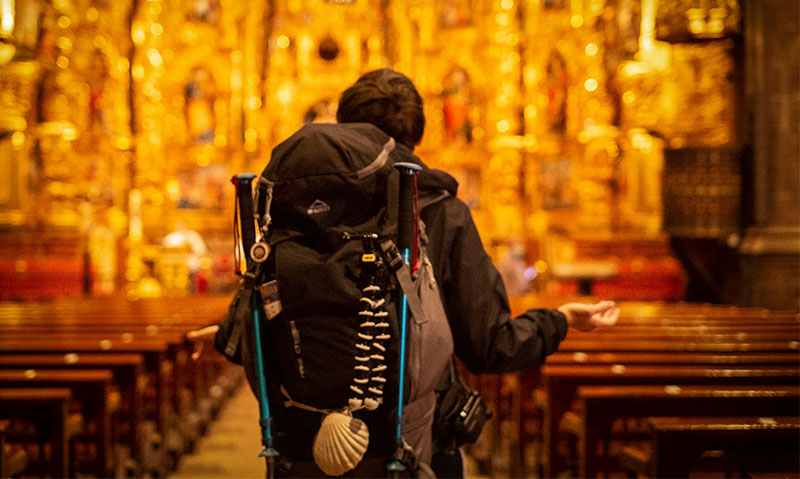
The Camino offers a unique mix of physical challenge and deep cultural history, with countless centuries-old churches open to walkers along the way.
Most Camino days settle into a pretty simple pattern. Wake up early, start walking before the heat, stop for coffee and breakfast, then aim to arrive in your next town by early or mid-afternoon.
For most walkers, 20 to 30 km per day is a realistic target, depending on terrain, weather, and how much you are carrying. On a first Camino, consistency matters more than hero days.
The rhythm is part of the point. After a day or two, your world gets smaller in the best way. You start thinking about the next yellow arrow, the next café, the next town, the next place to rest your feet. That simplicity is what makes the Camino feel different from a normal trip.
My rule: if you are debating between a shorter stage and a long ego stage, take the shorter one. The Camino rewards rhythm, patience, and steady days more than trying to prove something.
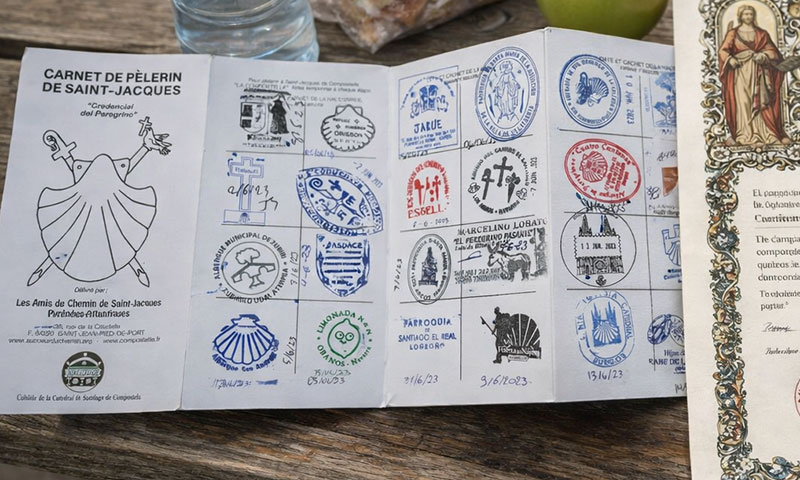
Your Credencial (pilgrim passport) fills up with stamps along the route and is required to earn your official Compostela certificate in Santiago.
The Credencial, or pilgrim passport, is one of the core Camino rituals. You use it to collect stamps along the route from hostels, churches, cafés, and other stops.
To receive the official Compostela certificate in Santiago, walkers need to cover at least the final 100 km, while cyclists must cover 200 km. Once you enter that final 100 km stretch, you should collect two stamps per day in your credencial, not just one. This helps confirm that you completed the route properly.
It is practical, but it also becomes one of your favorite keepsakes. By the time you reach Santiago, the stamps tell the story of your walk better than a normal souvenir ever could.
| Item | What It Is | Why It Matters |
|---|---|---|
| Credencial | The pilgrim passport | Needed for pilgrim hostels and certificate tracking |
| Daily stamps | Proof of progress, 2x day for last 100 km | Part logistics, part keepsake |
| Final 100 km | Minimum walking distance for Compostela | Why Sarria is so popular |
| Pilgrim Office | Where you claim the certificate in Santiago | The final official step |
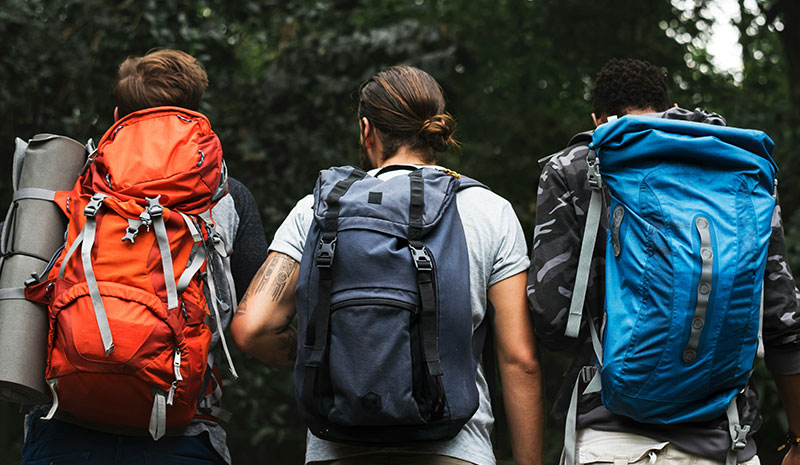
The smartest Camino pack is the one that stays light, simple, and easy to live out of for days on end.
The most repeated Camino advice is also the most useful: pack lighter than you think. A good guideline is keeping your pack around 10 percent of your body weight or less, ideally between 10 to 15 lbs (4.5 to 6.8 kg) fully loaded, excluding water.
Do not think of packing light as deprivation. Think of it as giving yourself a better Camino. Every extra item has to be carried, unpacked, repacked, dried, organized, and lived with. A lighter pack makes the walking easier and gives you more energy for the towns, meals, conversations, and quiet moments that make the Camino worth doing.
| Essential | Why It Matters | TLGA Take |
|---|---|---|
| 40L backpack | Enough space without encouraging overpacking | Sweet spot for most walkers |
| Broken-in trail runners or walking shoes | Comfort and blister prevention | More useful than heavy boots for many people |
| Two sets of walking clothes | Simple rotation and easier laundry | Keep it minimal |
| Rain shell | Weather protection without bulk | Essential in northern Spain |
| Sleep liner | Helpful in albergues | Small item, big value |
| Blister kit | Your most important problem-solving tool | Do not skip this |
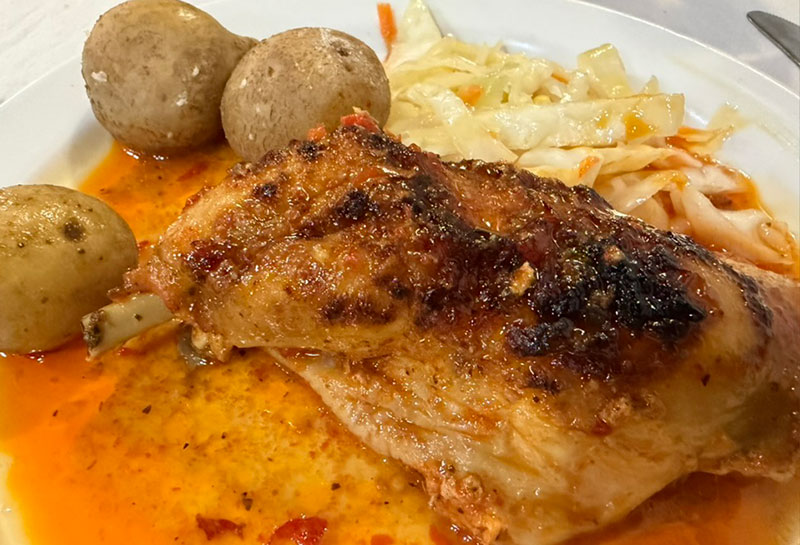
A classic Camino de Santiago pilgrim dinner after a long day of walking, typically featuring soup, roast chicken with potatoes, bread, dessert, and house wine in a cozy albergue restaurant.
Camino food is not about big fine-dining moments. It is about reliable, satisfying meals that fit the rhythm of walking. Coffee, toast, tortilla, bocadillos, soup, and a simple pilgrim dinner start to feel pretty great after a long day on the trail.
That is part of the charm. Food becomes fuel, comfort, and community all at once. A simple plate of chicken and potatoes can feel perfect when you have earned it mile by mile.
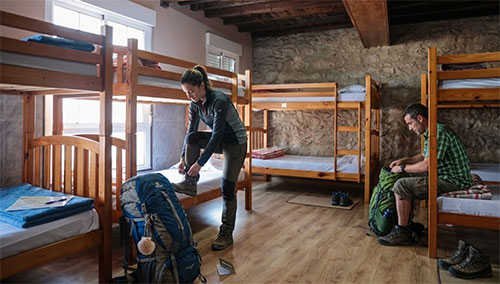
Albergues are dedicated pilgrim hostels that offer cheap, communal bunk beds and a great way to meet fellow walkers at the end of the day.
The Camino is one of the more affordable ways to travel through Spain, but your daily cost depends on how basic or comfortable you want the experience to be. Stay in municipal albergues and keep meals simple, and it stays very reasonable.
You can also make the Camino more comfortable without turning it into a luxury trip. Many first-time walkers mix albergues with the occasional private room, especially after a longer walking day or when they need better sleep.
| Category | Budget Range | TLGA Move |
|---|---|---|
| Municipal albergue bed | About €10 to €15 | Best value, but arrive earlier |
| Private albergue bed | About €15 to €25 | Worth it for more comfort on longer trips |
| Guesthouse or private room | About €40 to €100+ | Mix in strategically, not every night |
| Food per day | About €15 to €30+ | Breakfast light, lunch flexible, dinner simple |
| Total daily budget | About €25 to €50+ | Very manageable if you keep expectations realistic |
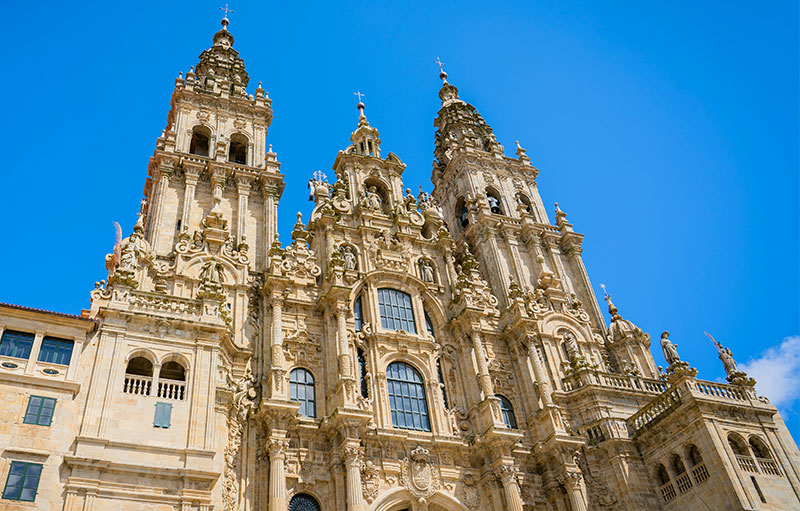
Arriving at the Cathedral of Santiago de Compostela is the emotional finish line and the ultimate payoff for pilgrims completing the Camino.
One of the easiest ways to enjoy the Camino more is to think beyond the mileage. The memorable parts are often the towns, not just the trail itself.
Each stop gives the walk texture. Some towns are beautiful. Some are practical. Some are just the place where you finally sit down, take your shoes off, and realize you made it through another day. That is part of the Camino too.
| Town or Stop | Why It Stands Out | Best For |
|---|---|---|
| Saint-Jean-Pied-de-Port | The classic start for the French Way | Big-trip energy and anticipation |
| Roncesvalles | Mountain setting after the Pyrenees crossing | First dramatic arrival |
| Burgos | Historic cathedral city with real urban weight | Culture and recovery day |
| León | Elegant old city and one of the best bigger stops | Food and architecture |
| Sarria | The practical launch point for the last 100 km | Short Camino starts |
| Portomarín | One of the most common early stops out of Sarria | Classic first stage feel |
| Santiago de Compostela | The final arrival and emotional payoff | Cathedral and completion moment |
The Camino is supposed to challenge you, but it does not need to break you. A few smart choices can make the difference between a rewarding walk and a trip that feels harder than it has to be.
No. Most first-timers are better off walking a shorter section. The final stretch from Sarria to Santiago is popular for a reason. It is manageable, scenic, social, and still ends with the classic arrival into Santiago.
For most travelers, Sarria to Santiago is the easiest first choice. If you have more time and want a slightly broader experience, the Camino Portugués from Porto is another great option.
It is more demanding than many people expect, but it is very doable with basic preparation. Walking regularly before the trip, wearing already-tested shoes, and keeping your pack light matter more than being an elite hiker.
No. The Camino welcomes people for many reasons. Albergues are for pilgrims walking the route, whether your motivation is spiritual, cultural, personal, or simply travel-focused.
It can be a smart option, especially if you have an injury concern, want a lighter daypack, or are doing the Camino more for the experience than the gear challenge. There is no prize for making it harder than it needs to be.
It depends on the season and the route. On popular stretches like Sarria to Santiago in spring, summer, and early fall, booking ahead can reduce stress. On quieter sections or shoulder-season walks, many pilgrims still keep things flexible.
For many walkers, lightweight trail runners or well-broken-in walking shoes work better than heavy hiking boots. Comfort, fit, and blister prevention matter more than choosing the most rugged-looking option.
Yes. A one-week Camino can still be deeply rewarding if you choose the right section. Sarria to Santiago is the most practical short route because it gives you several walking days, strong pilgrim infrastructure, and the emotional finish in Santiago.