
Travel Planning Hub
Start here to plan your trip, compare options, and explore every TLGA planning guide.
Packing & Gear Guide
What to pack, what to skip, and how to build a lighter travel setup that works.


Last updated: March 2026 by Corey Gasman
From the Editor:
I have traveled long enough to know that dead devices create more stress than almost anything else. Phones for maps, boarding passes, reservations. Laptops for work. Everything depends on power.
The mistake most people make is overpacking tech. Too many chargers, too many cables, too much guesswork. Then you end up digging through your bag at the airport gate trying to figure out why nothing is charging fast enough.
This guide is built to simplify that. One solid charger. The right cables. A backup plan for long travel days. That is it.
Your charging setup should feel invisible. You should not be thinking about it during your trip.
The best travel setups are built around one strong wall charger, a couple of reliable cables, and a power bank for long days. Everything else is optional.
Quick Setup:
65W charger → most travelers with a laptop
100W charger → multiple devices or sharing
Add a power bank → long travel days, flights, trains
If you only remember one thing: you do not need multiple chargers.
TLGA Rule: One good charger beats three average ones. Simplify your setup.
Read: Packing Guide
Start here: Travel Planning Playbook
If you only want the simple answer, get a compact 65W to 67W GaN charger with multiple ports. That gives most travelers enough power for a laptop, phone, and small accessories without packing separate chargers for every device.
Best for: One-bag travel, laptop travel days, and anyone who wants one small charger that handles the basics well.
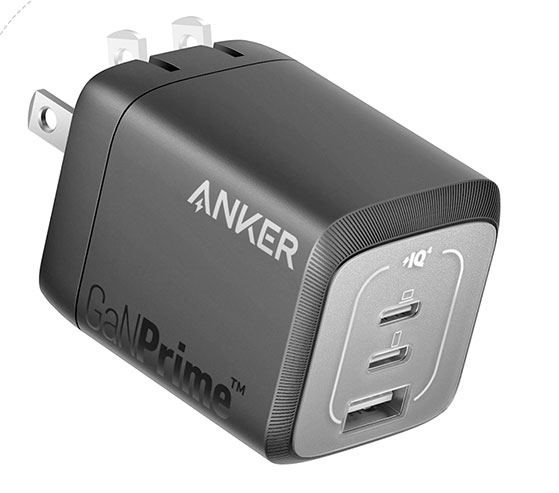
A compact 65W to 67W charger is the sweet spot for most travelers who carry a laptop, phone, and a few smaller devices.
You do not need the most powerful charger on the market. You need the right charger for the way you actually travel. A weekend trip, a two-week Europe trip, and a remote work month all need slightly different setups.
Nekteck 65W USB-C GaN Charger
Best for a simple, affordable laptop-friendly charger that does not overcomplicate your packing list.
UGREEN Nexode 100W USB-C GaN Charger
Best if you are sharing outlets, charging a laptop and phone together, or packing one charger for multiple devices.
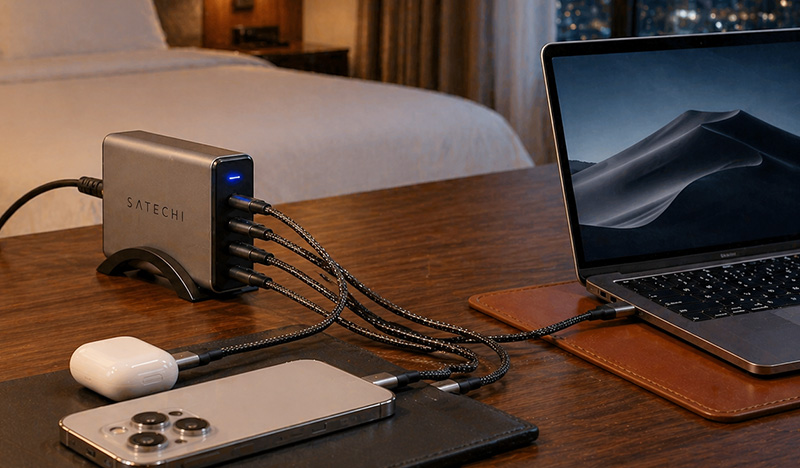
Satechi 165W USB-C 4-Port PD GaN Charger
Best for digital nomads, apartment stays, and longer trips where your hotel desk turns into a charging station.
| Charger Type | Best For | What to Know |
|---|---|---|
| 35W dual-port | Phones, earbuds, watch, small devices | Good for light travel, weak for most laptop use |
| 65W to 67W GaN | Most laptop travelers | The best all-around travel size |
| 100W multi-port | Couples, remote workers, heavier laptop use | More flexible, still packable |
| 165W desktop charger | Long stays and desk setups | Great power, less pocket-friendly |
A wall charger is great when you have an outlet. A power bank is what saves you when you are on a long airport day, stuck on a train, taking photos all afternoon, or using your phone for maps in a new city.
For most phone-only trips, a smaller power bank is enough. It keeps your phone alive during long days without adding too much weight to your sling bag or daypack.
If you want to charge a laptop from a power bank, look for USB-C PD and enough wattage to actually support your laptop. This is where cheap power banks often disappoint.
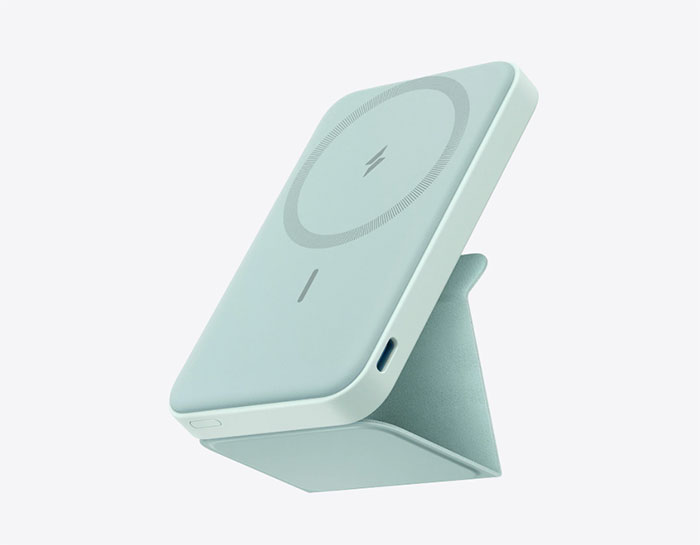
MagSafe-style batteries are best for easy top-ups on travel days, not for replacing your main charger.
Wireless charging is not the fastest way to charge your phone, but it is convenient. For travel, I like magnetic batteries for airports, cafes, walking around cities, and quick top-ups when you do not want to deal with cables.
Why it works: It is slim, easy to carry, and the built-in kickstand is more useful than it sounds when you are sitting in an airport or coffee shop.
Why it works: It gives you more battery capacity while still staying small enough for real travel use.
Why it works: Belkin usually has a cleaner build quality and a more polished Apple-friendly feel.
Why it works: It is a more affordable way to get magnetic charging for casual travel.
Why people buy it: It works cleanly with iPhones, but the capacity is limited for the price.
The charger gets all the attention, but the boring accessories are usually what save you. A great wall charger does not help much if your cable is weak or your plug does not fit the outlet.
Bring at least one cable that is actually rated for laptop charging. A weak cable can bottleneck a good charger.
If you are leaving North America, bring the correct plug adapter. Your charger still needs to physically fit the wall outlet.
A short cable is great for planes, power banks, cafes, and charging from a small outlet without a mess of cord.
GaN stands for Gallium Nitride. In normal terms, it helps chargers stay smaller and more efficient, especially when you need more power.
For many travel laptops, yes. If you have a larger laptop and do heavier editing, gaming, or design work while plugged in, a 100W charger may be a better fit.
You can. The reason to upgrade is that many laptop chargers are bulkier than needed and only charge one device. A good travel charger can replace multiple bricks.
If you do long airport days, train travel, road trips, full days of sightseeing, or use your phone heavily for maps and photos, yes. If you mostly go from hotel to cafe to hotel, it is more optional.
Sometimes. Wireless charging is slower than a cable, but magnetic power banks are very convenient for quick top-ups during the day.